VPAT Master Guide: Certify Once, Comply Everywhere – How Product Owners and QA Teams Build a Global Accessibility Compliance Shield. VPAT Website Mobile App
What’s Inside
- The Accessibility Landscape: Compliance as Liability
- Understanding VPAT and ACR: The Heart of Accessibility Certification
- Global Regulatory Context: Why VPAT Matters More Than Ever
- VPAT Versions Explained: 2.4, 2.5, and Beyond
- Anatomy of a High-Quality ACR
- Writing ACRs That Withstand Legal Scrutiny
- QA and Testing Framework Supporting ACRs
- Procurement and Vendor Evaluation Using ACRs
- VPAT as a Legal Defense: The “Compliance Shield”
- Maintaining VPAT Validity: The 12-Month Rule
- Integrating Accessibility into DevOps
- ACR Governance: Policies, Logs, and Transparency
- Sector-Specific VPAT Applications
- VPAT Maturity Model for Enterprises
- ROI of a Strong VPAT Program
- VPAT 2.5 and WCAG 2.2: Technical Alignment
- Common VPAT Mistakes and How to Avoid Them
- Conclusion: VPAT as the Universal Compliance Passport
- FAQs: VPAT / ACR & Accessibility Compliance
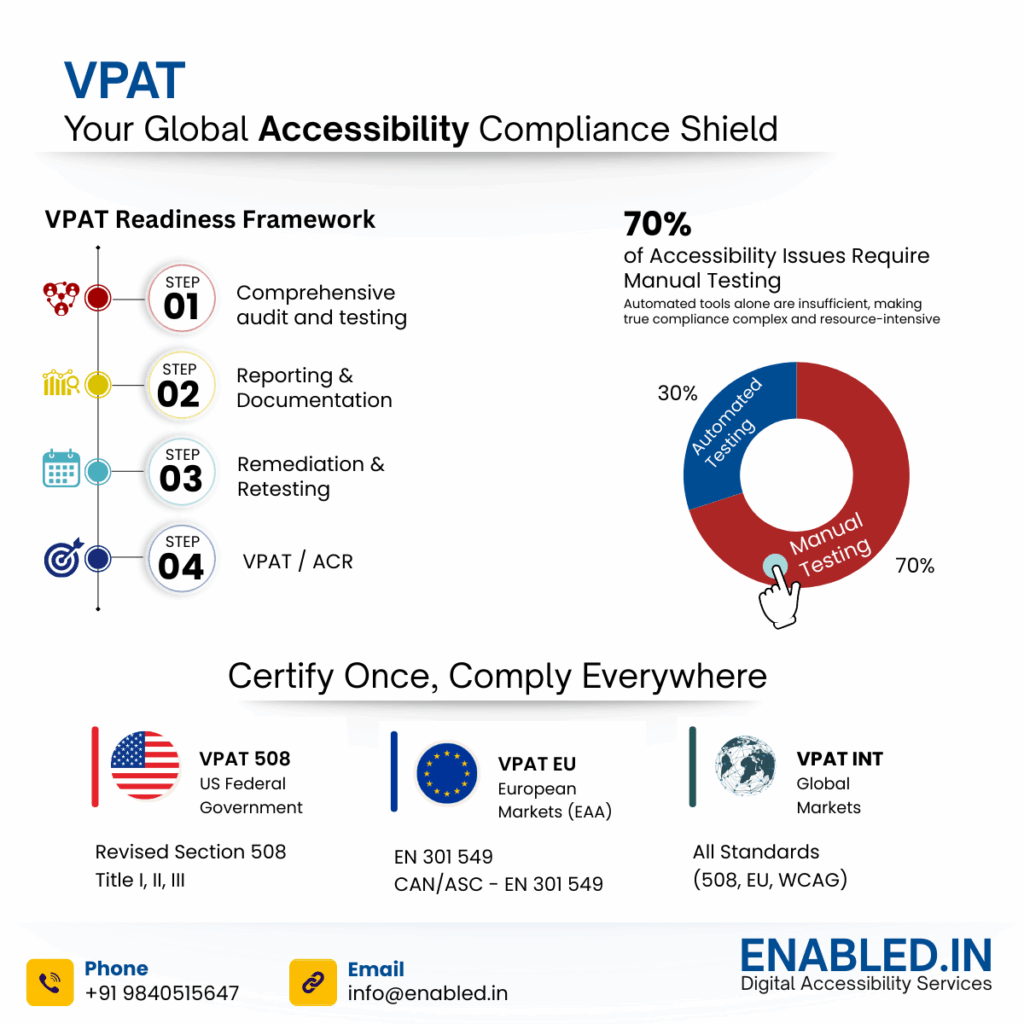
1. The Accessibility Landscape: Compliance as Liability
The digital accessibility has moved from a realm of voluntary inclusion to one of strict legal liability.
Across both the United States and European Union, organizations must demonstrate verifiable digital accessibility compliance. Otherwise, they risk regulatory penalties. There is also the potential for contract ineligibility and public litigation.
For Product Owners (POs) and Quality Assurance (QA) teams, the VPAT (Voluntary Product Accessibility Template) is a mission-critical compliance instrument. Its resulting Accessibility Conformance Report (ACR) is also critical.
Together, they represent documented proof that a digital product has been evaluated against recognized accessibility standards like WCAG 2.2 AA, Section 508, and the European Accessibility Act (EAA).
2. Understanding VPAT and ACR: The Heart of Accessibility Certification
What Is a VPAT?
A Voluntary Product Accessibility Template (VPAT®) is a standardized document created by the Information Technology Industry Council (ITI). It enables vendors to report the level of conformance of their product or service to accessibility standards.
What Is an ACR?
An Accessibility Conformance Report (ACR) is the completed VPAT document. It is customized to describe how a specific product conforms. It also explains how it fails to conform to accessibility standards.
It’s the official record used in:
- Government procurement
- Enterprise vendor evaluations
- Legal defense and risk mitigation
In the 2026 “Certify Once, Comply Everywhere” model, a credible, current ACR serves as the “compliance shield”. It protects an organization across multiple regulatory environments.
3. Global Regulatory Context: Why VPAT Matters More Than Ever
United States
- ADA Title II Final Rule (DOJ, April 2024):
Mandates WCAG 2.1 AA for all state and local government websites and apps.- April 24, 2026 – Entities with 50,000+ residents
- April 26, 2027 – Smaller entities
- Section 508:
Still required for all U.S. federal agencies and educational institutions. - California AB 1757:
Enforces WCAG 2.1 AA with penalties up to $4,000 per violation under the Unruh Civil Rights Act.
European Union
- European Accessibility Act (EAA) – Effective June 28, 2025, applies to consumer products, eCommerce, banking, transport, and digital media.
- EN 301 549 v3.2.1:
Incorporates WCAG 2.1 AA and adds biometric and non-web software accessibility requirements.
The Result:
Procurement teams now require a valid ACR for contract eligibility in most sectors. A single VPAT 2.5 INT can fulfill both U.S. and EU documentation requirements embodying the “Certify Once, Comply Everywhere” approach.
4. VPAT Versions Explained: 2.4, 2.5, and Beyond
| VPAT Edition | Purpose / Use Case | Covers |
|---|---|---|
| VPAT 2.5 508 | For U.S. Federal procurement | WCAG 2.0 & Revised Section 508 |
| VPAT 2.5 EU | For EU and EAA markets | EN 301 549 & WCAG 2.1 |
| VPAT 2.5 INT | For global conformance mapping | WCAG 2.2, 508, and EN 301 549 |
The VPAT 2.5 INT edition is the recommended version for 2026, as it:
- Supports WCAG 2.2 success criteria
- Aligns with multiple regulatory baselines
- Simplifies cross-jurisdictional procurement
5. Anatomy of a High-Quality ACR
A credible ACR is not a marketing brochure it’s a technical disclosure document that reflects deep evaluation.
Structure Overview
- Executive Summary: Overview of scope and standards evaluated.
- Evaluation Methods: Description of testing methods and tools.
- Conformance Table: Standard-by-standard compliance statements.
- Remarks and Explanations: Evidence supporting each claim.
- Reviewer Details: Date, tester name, and assistive technologies used.
Core Conformance Terminology
- Supports: Fully meets the standard.
- Partially Supports: Meets some aspects, but with exceptions.
- Does Not Support: Does not meet the requirement.
- Not Applicable: No relevant functionality.
6. Writing ACRs That Withstand Legal Scrutiny
Bad Example
“The product is accessible.”
Good Example
“Supports keyboard navigation. All interactive elements, including navigation menus and form inputs, are reachable via Tab and Shift+Tab. Visible focus indicators maintain a 3:1 contrast ratio against background colors.”
Key ACR Writing Principles
- Be Specific: Identify what was tested and how.
- Use Evidence: Mention test tools and AT used.
- Note Exceptions Transparently: Acknowledge known barriers and mitigation plans.
- Avoid Absolutes: Never claim “100% accessible.”
Each remark should allow an auditor, attorney, or customer to verify accessibility without ambiguity.
7. QA and Testing Framework Supporting ACRs
A VPAT is only as strong as the testing behind it.
The 30/70 Rule
- 30% of issues: Detected via automated tools (e.g., Axe, WAVE, Lighthouse).
- 70% of issues: Require manual testing and real AT users.
Recommended Testing Matrix
| Type | Focus | Tools / AT |
|---|---|---|
| Automated | Missing alt-text, contrast, labels | Axe, WAVE, Pa11y |
| Manual Expert | Keyboard traps, reading order, ARIA states | Browser Inspectors, Color Contrast Analyzer |
| Assistive Tech | Screen reader/gesture compatibility | JAWS, NVDA, VoiceOver, TalkBack |
| User Testing | Real-world usability | Task-based testing with disability representation |
QA teams should document all testing evidence as ACR appendices strengthening traceability and defensibility.
8. Procurement and Vendor Evaluation Using ACRs
Procurement Readiness Checklist
- Valid VPAT 2.5 (updated within 12 months)
- Conducted by accessibility-trained professionals
- Includes assistive technology testing
- Transparent “Remarks and Explanations”
- Includes remediation roadmap
Vendor Red Flags
- Claims of “100% compliance”
- No ACR provided
- ACR older than one year
- Automated-only evaluations
- “Remarks” sections filled with vague language
Procurement officers now assign Accessibility Confidence Levels (Low/Medium/High) based on the ACR’s depth and credibility.
9. VPAT as a Legal Defense: The “Compliance Shield”
When accessibility complaints or lawsuits arise, the ACR becomes your strongest legal asset.
Why It Matters
- Demonstrates due diligence and good-faith effort
- Proves proactive conformance testing
- Supports claims of reasonable accommodation
Courts and regulators look for evidence of continuous monitoring and remediation. A current, detailed VPAT-supported ACR shows your organization has acted responsibly.
10. Maintaining VPAT Validity: The 12-Month Rule
An ACR older than 12 months is considered stale in procurement and audit scenarios.
Best Practices for Renewal
- Update your VPAT annually or after every major product release.
- Use version control to track VPAT iterations.
- Maintain a VPAT change log that records updates and reasons for revision.
This not only sustains compliance but also simplifies procurement cycles and contract renewals.
11. Integrating Accessibility into DevOps
To sustain ACR quality, accessibility must live within the SDLC (Software Development Lifecycle).
Agile Integration
- Add accessibility to User Story Acceptance Criteria
- Include VPAT verification in Sprint Reviews
- Automate early detection with CI/CD testing hooks
DevOps Integration
- Embed accessibility scans (Axe CLI, Deque CI) in pipelines
- Generate nightly reports and track metrics in Jira or Azure DevOps
- Require QA sign-off before releases affecting accessibility-critical paths
This ensures every build contributes to maintaining ACR validity.
12. ACR Governance: Policies, Logs, and Transparency
Accessibility Statement
Publish a live accessibility statement that:
- References the current ACR
- Lists known issues and remediation timelines
- Provides contact information for feedback
Remediation Logs
Document the lifecycle of each issue:
| Issue ID | Date Logged | Severity | Fix Date | Verification |
|---|---|---|---|---|
| EN-214 | 2026-02-15 | High | 2026-03-01 | Passed manual QA |
Such documentation shows proactive governance and provides a defendable audit trail.
13. Sector-Specific VPAT Applications
| Sector | VPAT Application Focus | ACR Considerations |
|---|---|---|
| Government / Public Sector | Section 508 and ADA | Must align with DOJ 2024 Rule |
| Education (LMS / EdTech) | 508 + EN 301 549 | Test PDFs, MathML, timed quizzes |
| Banking / FinTech | EN 301 549 Clause 5.3 | Support biometric login alternatives |
| eCommerce | EAA & WCAG 2.2 | Accessible shopping flows, aria-live regions |
| Travel / Media | EN 301 549 11.6 | Test autoplay media and date pickers |
Each industry’s ACR should map accessibility findings directly to these sector requirements.
14. VPAT Maturity Model for Enterprises
| Maturity Level | Description | VPAT Status |
|---|---|---|
| 1 – Reactive | Accessibility addressed post-complaint | No VPAT or outdated ACR |
| 2 – Procedural | VPAT created for contracts only | Minimal evidence |
| 3 – Process-Driven | Annual VPAT renewal and QA audits | Traceable reporting |
| 4 – Integrated | VPAT integrated into DevOps lifecycle | Automated updates |
| 5 – Leadership | Accessibility as innovation metric | Public ACR transparency |
The goal is to progress from Level 1 (Reactive) to Level 4–5 (Integrated/Leadership), ensuring sustainability and legal resilience.
15. ROI of a Strong VPAT Program
| Benefit Category | Impact |
|---|---|
| Legal Protection | Reduces litigation risk |
| Procurement Readiness | Increases contract eligibility |
| Brand Reputation | Builds customer trust |
| Operational Efficiency | Reduces rework costs |
| ESG Alignment | Supports social governance metrics |
A robust VPAT program typically delivers a 300% ROI within two years (Forrester, 2025). It achieves this through efficiency, risk mitigation, and brand differentiation.
16. VPAT 2.5 and WCAG 2.2: Technical Alignment
Why WCAG 2.2 Matters
The WCAG 2.2 update introduces critical success criteria for:
- Touch targets (2.5.8)
- Dragging movements (2.5.7)
- Consistent help (3.2.6)
VPAT 2.5 INT integrates these new guidelines positioning your ACR as future-ready for both U.S. and EU harmonization.
17. Common VPAT Mistakes and How to Avoid Them
| Mistake | Impact | Correction |
|---|---|---|
| Outdated VPAT (>12 months) | Disqualifies vendor bids | Schedule annual refresh |
| Generic responses | Reduces confidence | Add detailed test results |
| No assistive tech testing | Undermines validity | Include AT user evaluation |
| “Will fix later” remarks | Seen as non-compliance | Include fixed timeline and plan |
Every VPAT should read as proof of testing, not intent to comply.
18. Conclusion: VPAT as the Universal Compliance Passport
The VPAT and ACR have evolved from procurement documents into strategic compliance assets.
In the era of “Certify Once, Comply Everywhere,” they form the backbone of digital accountability.
By building transparent, evidence-based ACRs and maintaining annual renewals, organizations can:
- Protect themselves legally
- Win global contracts
- Build public trust
- Lead the accessibility movement into the next decade
A well-maintained VPAT is not just a document, it’s your organization’s accessibility passport to global markets.
19. FAQs : VPAT / ACR & Accessibility Compliance
1. What is a VPAT?
A VPAT (Voluntary Product Accessibility Template) is a standardized template used to evaluate and report how accessible a product or service is according to standards like WCAG, Section 508, and EN 301 549.
2. What is an ACR (Accessibility Conformance Report)?
An ACR is the completed version of a VPAT. It documents test results, conformance levels, and detailed remarks on accessibility compliance.
3. Is a VPAT legally required in the U.S.?
While not explicitly mandated by law, it is required for Section 508 procurement and strongly recommended for any organization dealing with federal, state, or educational entities.
4. How often should a VPAT be updated?
VPATs should be reviewed and updated annually or whenever significant product changes occur. Most procurement bodies reject VPATs older than 12 months.
5. What are the current VPAT versions?
VPAT 2.5 508 – U.S. Federal (Section 508); VPAT 2.5 EU – Europe (EN 301 549 / EAA); VPAT 2.5 INT – Global (WCAG 2.2 + 508 + EN 301 549). Use VPAT 2.5 INT in 2026 for maximum coverage.
6. What does VPAT 2.5 INT include?
It maps compliance across WCAG 2.1 / 2.2, Section 508 (U.S.), and EN 301 549 (EU). This makes it ideal for global organizations following a “Certify Once, Comply Everywhere” model.
7. What accessibility standards does a VPAT evaluate?
A VPAT measures conformance against WCAG (Web Content Accessibility Guidelines), Section 508 of the Rehabilitation Act (U.S.), and EN 301 549 (EU Accessibility Standard).
8. What are the standard conformance levels in a VPAT?
Supports (Fully meets), Partially Supports (Meets some aspects), Does Not Support (Fails), and Not Applicable (Feature not relevant to the product).
9. What’s the difference between a VPAT and an ACR?
VPAT is the blank reporting template, while the ACR is the completed document showing test results. An ACR = “Completed VPAT.”
10. What should be included in the “Evaluation Methods Used” section?
Describe your testing approach (manual/automated), assistive technologies (JAWS, NVDA, VoiceOver), browsers, devices, and involvement of real users with disabilities.
11. How can I improve the credibility of my VPAT?
Include manual testing results, use real assistive technology users, provide transparent evidence (screenshots/logs), and avoid vague or future-tense claims.
12. Who should prepare a VPAT?
Ideally, accessibility-trained QA analysts, developers, and compliance experts. Third-party certification adds credibility for high-stakes procurements.
13. How is WCAG 2.2 different from 2.1?
WCAG 2.2 introduces criteria for touch target size (2.5.8), dragging movements (2.5.7), consistent help (3.2.6), and visible focus (2.4.11).
14. How do I handle “Partially Supports” in a VPAT?
Be transparent: Identify the affected feature, explain user impact, and provide a remediation plan with a target completion date.
15. Can a vendor self-assess their VPAT?
Yes, but it must be fact-based. Third-party validation is preferred for high-risk or enterprise-level products.
16. What’s the purpose of the “Remarks and Explanations” column?
To justify every compliance claim with evidence. Example: “Supports keyboard navigation across all screens. Focus indicators visible with 3:1 contrast.”
17. How does the VPAT align with ADA compliance?
While ADA doesn’t require VPATs explicitly, the document serves as proof of due diligence under ADA Titles II & III and helps mitigate litigation risk.
18. Is a VPAT required in Europe?
Yes—under the European Accessibility Act (EAA), organizations must demonstrate accessibility conformance. A VPAT 2.5 EU or INT is the accepted standard.
19. How does VPAT help in the procurement process?
Procurement teams use VPATs to evaluate accessibility risk, compare vendors, ensure Section 508 / EAA compliance, and validate conformance during evaluation.
20. Can VPATs cover mobile apps and software?
Yes. VPATs apply to all ICT products, including websites, mobile apps, desktop software, and hardware with digital interfaces.
21. What happens if a VPAT contains false claims?
False reporting can lead to breach of contract, legal action under ADA or EAA, and procurement blacklisting. Always ensure statements are accurate.
22. How long does it take to complete a VPAT?
Depending on complexity: Simple products take 2–4 weeks; complex enterprise platforms take 6–8 weeks including manual testing and review.
23. What’s the difference between “Not Applicable” and “Not Evaluated”?
Not Applicable means the product lacks that functionality. Not Evaluated means the feature exists but wasn’t tested; this should generally be avoided.
24. What’s the best way to present VPAT findings?
Publish as an accessible PDF or HTML document. Include the version number, evaluation date, and link it in your product’s Accessibility Statement.
25. How do VPATs support ESG (Environmental, Social, Governance) goals?
Accessibility aligns with the social responsibility pillar of ESG. Publishing VPATs demonstrates your brand’s ethical and inclusive governance commitment.
26. Who reviews VPATs in the procurement process?
Typically government contracting officers, accessibility specialists, legal teams, and technical evaluation committees.
27. What are the common VPAT mistakes to avoid?
Avoid copy-paste responses, vague remarks, missing assistive technology testing evidence, and using outdated versions or standards.
28. How do VPATs serve as a “Compliance Shield”?
A detailed VPAT demonstrates proactive compliance, reduces legal risk, and strengthens procurement eligibility for global markets.
29. Can VPATs be shared publicly?
Yes—many leading organizations like Microsoft and Google publish their ACRs online to foster transparency and user trust.
30. How does VPAT align with Section 508?
Section 508 mandates accessibility for all federal ICT. A VPAT 2.5 508 version specifically documents compliance with these federal regulations.
31. What are best practices for maintaining VPATs?
Assign clear ownership (QA or Compliance), track changes via version control, and schedule mandatory annual reviews.
32. How do you integrate VPAT updates into DevOps?
Add VPAT validation into CI/CD pipelines, re-run accessibility scans per release, and store historical versions in a compliance repository.
33. Can a VPAT include third-party components?
Yes—but you must identify which parts of your product depend on third-party integrations and declare their specific accessibility limitations.
34. How can small businesses handle VPAT requirements cost-effectively?
Use hybrid testing (automated + manual), leverage open-source tools, and self-certify transparently. A partial VPAT is better than none.
35. How does the VPAT tie into the “Certify Once, Comply Everywhere” model?
VPAT 2.5 INT aligns WCAG, Section 508, and EN 301 549 into a single matrix, allowing for global certification through one consolidated report.
36. What is the “Compliance Shield” concept?
It is the strategic use of VPAT and ACR documentation as a legal and procurement defense layer to shield organizations from fines and contract risks.
37. How do VPATs relate to continuous accessibility monitoring?
Integrate automated scans into your workflow. Regular updates ensure your VPAT remains accurate as your product evolves.
38. How do you select the right auditor for VPAT verification?
Choose auditors who are IAAP-certified accessibility specialists with specific experience in WCAG 2.2 and EN 301 549 standards.
39. What’s the future of VPAT reporting?
Expect AI-assisted VPAT generation, automated validation dashboards, and live conformance analytics by 2028–2030.
40. What’s the biggest VPAT takeaway for 2026?
The VPAT is no longer optional—it’s a strategic compliance passport. Maintaining a credible VPAT 2.5 INT ensures global market access.
Need a VPAT for a Mobile App Accessibility?
Explore Mobile App ADA 508 Accessibility Audit & VPAT Services
Talk to Our Accessibility Experts
Whether you’re responding to an RFP or preparing for procurement, we’re here to help. We also support improving inclusion across your Booking web and mobile app platform.
Contact us today to discuss your Mobile App accessibility audit and VPAT requirements. Take the next step toward inclusive, compliant ticket systems.
Sathasivam Kannupayan
sathasivam@enabled.in
www.enabled.in
+91 98405 15647