WCAG-EM 2: Complete Guide to W3C Accessibility Evaluation Methodology
The digital world should be accessible to everyone including people with disabilities. Websites, mobile apps, and digital services must be designed so that all users can access information easily. The World Wide Web Consortium (W3C) introduced a structured evaluation process. This process is known as WCAG-EM 2 and helps organizations verify accessibility compliance.
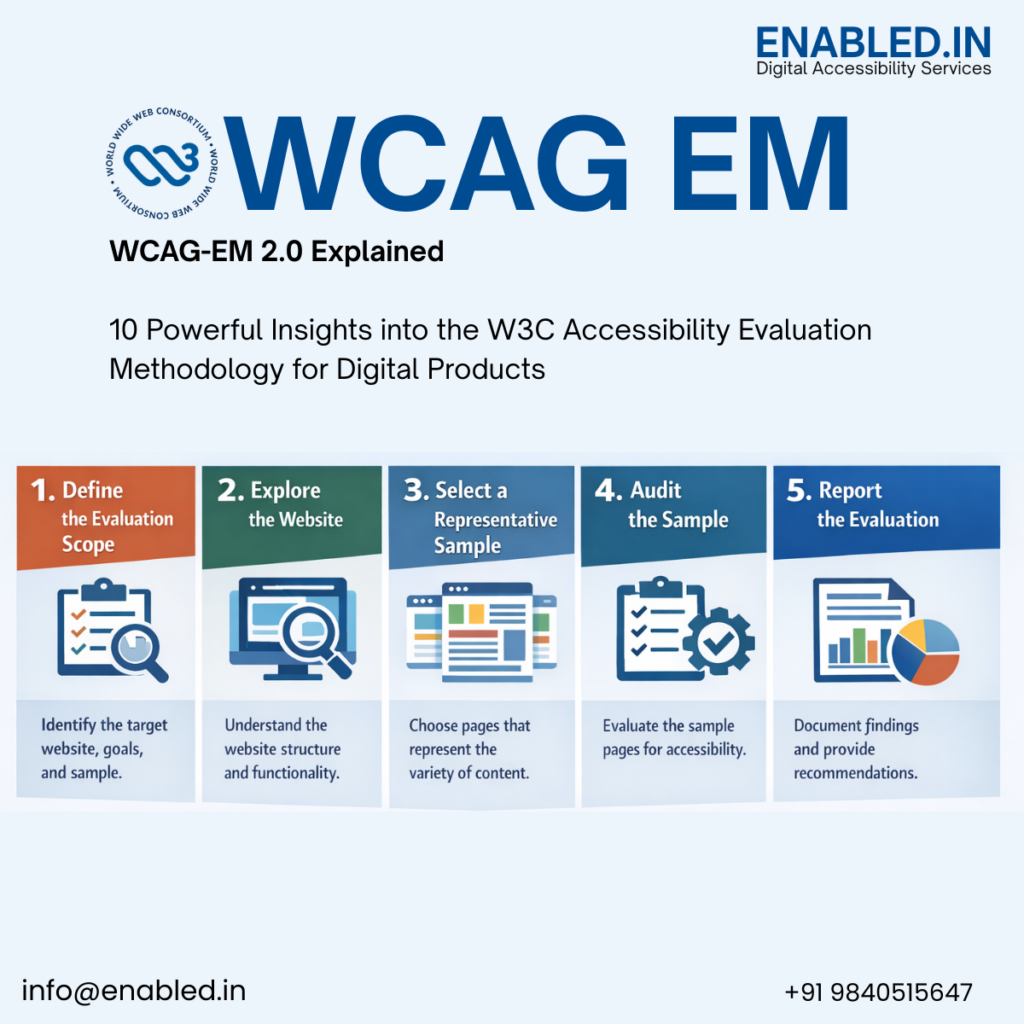
WCAG-EM 2 (Web Content Accessibility Guidelines Evaluation Methodology) provides a step-by-step process. It is used to evaluate how well digital products conform to WCAG standards. It helps organizations, developers, and auditors perform consistent accessibility assessments across websites, applications, and digital platforms.
This comprehensive guide provides information on everything you need to know about WCAG-EM 2. It covers its purpose and structure. The guide also details the evaluation steps and practical implementation.
Understanding WCAG and Digital Accessibility
Before diving into WCAG-EM 2, it is important to understand WCAG (Web Content Accessibility Guidelines).
WCAG is the globally recognized standard. It makes digital content accessible to people with disabilities such as visual impairments, hearing loss, mobility limitations, and cognitive disabilities.
WCAG guidelines are built on four fundamental principles:
| Principle | Description |
|---|---|
| Perceivable | Users must be able to perceive content (e.g., text alternatives for images). |
| Operable | Users must be able to navigate and interact with the interface. |
| Understandable | Information and operations must be clear and predictable. |
| Robust | Content must work with assistive technologies and various devices. |
Each principle includes testable success criteria at three levels:
- Level A (basic accessibility)
- Level AA (recommended standard)
- Level AAA (highest accessibility level)
WCAG explains what accessibility requirements exist. However, it does not specify exactly how to evaluate a website or digital product. That is where WCAG-EM 2 comes in.
What is WCAG-EM 2?
WCAG-EM 2 stands for Web Content Accessibility Guidelines Evaluation Methodology version 2. It is a methodology created by W3C that provides a structured process for evaluating accessibility compliance.
The methodology describes how evaluators should perform accessibility assessments. It outlines defining the scope. It includes selecting representative samples. It also involves testing content and reporting results.
Unlike WCAG itself, WCAG-EM:
- Does not introduce new accessibility requirements
- Does not replace WCAG standards
- Instead provides guidance on how to conduct accessibility evaluations properly
The new version, WCAG-EM 2, expands the approach. It supports not only websites but also mobile apps and other digital products.
Why WCAG-EM 2 is Important for Accessibility Compliance
Organizations worldwide rely on WCAG-EM 2 for several reasons.
1. Standardized Accessibility Evaluation
WCAG-EM 2 ensures evaluations follow a consistent structure, reducing variability between audits.
2. Supports Legal Compliance
Many accessibility laws reference WCAG standards. Proper evaluation methods help demonstrate compliance.
3. Improves Accessibility Quality
The methodology helps identify barriers affecting users with disabilities.
4. Enables Reliable Accessibility Reports
Using WCAG-EM ensures evaluation results are credible and reproducible.
5. Works for Large Digital Platforms
Instead of checking every page, evaluators can analyze representative samples of content.
This makes the methodology particularly useful for large websites and complex applications.
Key Differences Between WCAG-EM 1 and WCAG-EM 2
| Feature | WCAG-EM 1 | WCAG-EM 2 |
|---|---|---|
| Focus | Websites only | Websites, apps, and digital products |
| Evaluation scope | Web pages | Broader digital interfaces |
| Reporting | Standard reports | Enhanced reporting options |
| Usage | Website audits | Digital accessibility evaluations |
The main improvement is expanded coverage for modern digital environments.
Who Should Use WCAG-EM 2
WCAG-EM 2 is useful for many stakeholders in the digital ecosystem.
Accessibility Consultants
Professionals who conduct accessibility audits.
Web Developers
Teams that want to test accessibility during development.
Product Owners
Organizations that need accessibility reports for compliance.
Government Agencies
Public sector entities required to meet accessibility regulations.
Accessibility Testing Providers
Companies offering accessibility evaluation services.
The WCAG-EM 2 Evaluation Process (Step-by-Step)
The methodology defines a structured process for evaluating digital accessibility.
Step 1: Define the Evaluation Scope
The first step involves determining:
- What digital product will be evaluated
- Which WCAG version applies (e.g., WCAG 2.2)
- Which conformance level is required (A, AA, AAA)
This stage also identifies the target audience and technology environment.
Step 2: Explore the Target Product
Evaluators explore the digital product to understand its structure.
Typical activities include:
- Mapping website architecture
- Identifying page templates
- Listing functionality and workflows
- Reviewing navigation structures
This helps determine how representative samples should be selected.
Step 3: Select Representative Samples
Large digital products often contain thousands of pages. Evaluating every page is not practical.
WCAG-EM recommends selecting representative samples, such as:
- Homepage
- Navigation pages
- Forms
- Media content
- Transaction flows
- Error messages
This ensures the evaluation reflects the overall accessibility of the product.
Step 4: Audit the Sample Content
Each selected page or interface is tested against WCAG success criteria.
Evaluators use several testing methods:
Manual Testing
Human inspection for accessibility issues.
Automated Testing Tools
Accessibility checkers identify common errors.
Assistive Technology Testing
Testing using tools such as screen readers.
Keyboard Navigation Testing
Ensuring users can interact without a mouse.
This combination provides accurate accessibility results.
Step 5: Report Evaluation Results
After the audit, evaluators document findings in an accessibility report.
Typical report elements include:
- Scope of evaluation
- Methodology used
- Pages evaluated
- Accessibility issues found
- WCAG success criteria results
- Recommendations for improvement
Some reports may also include:
- Accessibility statements
- Aggregated accessibility scores
- Machine-readable reports
These help organizations track progress over time.
Benefits of Using WCAG-EM 2
Organizations adopting WCAG-EM 2 gain several advantages.
Consistent Evaluation Method
Ensures accessibility audits follow industry best practices.
Reliable Accessibility Reporting
Reports generated using WCAG-EM carry greater credibility.
Scalability
Works effectively for large digital platforms.
Compliance Support
Helps organizations meet accessibility regulations.
Improved User Experience
Ultimately benefits all users, including those with disabilities.
Tools That Support WCAG-EM Evaluations
Several tools assist evaluators in following WCAG-EM methodology.
Examples include:
- Accessibility testing tools
- Browser accessibility extensions
- Automated scanners
- Screen reader software
- Accessibility reporting tools
One example is the WCAG-EM Report Tool, which helps generate evaluation reports according to the methodology.
You can also learn more directly from the official documentation:
🔗 https://www.w3.org/TR/wcag-em-2/
Best Practices for Accessibility Evaluation
To maximize the effectiveness of WCAG-EM evaluations, experts recommend:
Combine Automated and Manual Testing
Automated tools detect only a portion of accessibility issues.
Include Real Users with Disabilities
User testing reveals real-world accessibility barriers.
Test Across Devices
Accessibility should work on desktop, mobile, and tablets.
Evaluate Key User Journeys
Focus on critical workflows like login, checkout, and forms.
Repeat Evaluations Regularly
Accessibility should be monitored continuously.
Common Accessibility Issues Found During WCAG Evaluations
During accessibility audits, evaluators frequently identify issues such as:
- Missing image alt text
- Poor color contrast
- Inaccessible forms
- Keyboard navigation problems
- Missing captions for videos
- Improper heading structure
Fixing these problems significantly improves usability for all users.
Future of Accessibility Evaluation
Accessibility expectations are evolving rapidly.
Key trends include:
- AI-assisted accessibility testing
- Automated accessibility monitoring
- Integration into DevOps pipelines
- Accessibility-first design strategies
As digital ecosystems grow, structured evaluation frameworks like WCAG-EM 2 will become even more essential.
Frequently Asked Questions (FAQs)
What does WCAG-EM stand for?
WCAG-EM stands for Web Content Accessibility Guidelines Evaluation Methodology, a framework for evaluating digital accessibility.
What is the purpose of WCAG-EM 2?
WCAG-EM 2 provides a step-by-step process for evaluating how well digital products meet WCAG accessibility standards.
Does WCAG-EM replace WCAG guidelines?
No. WCAG-EM does not replace WCAG. It simply describes how to evaluate accessibility compliance.
Can WCAG-EM be used for mobile apps?
Yes. WCAG-EM 2 expands the methodology to cover apps and other digital products, not just websites.
Is WCAG-EM required by law?
The methodology itself is not mandatory, but many accessibility audits use it to demonstrate compliance with WCAG.
Who created WCAG-EM?
WCAG-EM was developed by the World Wide Web Consortium (W3C) as part of its Web Accessibility Initiative.
Conclusion
Digital accessibility is no longer optional it is a fundamental requirement for inclusive digital experiences. WCAG-EM 2 provides a practical and structured methodology for evaluating accessibility across websites, apps, and other digital products.
By following this evaluation framework, organizations can:
- Ensure WCAG compliance
- Identify accessibility barriers
- Improve usability for people with disabilities
- Deliver inclusive digital experiences
As accessibility standards continue to evolve, methodologies like WCAG-EM 2 will remain essential for building a more inclusive internet.
Contact Enabled.in
Website: https://enabled.in
Email: sathasivam@enabled.in
Phone: +91-9840515647
If your organization is preparing for WCAG 3.0 or strengthening WCAG 2.2 compliance, our accessibility specialists are ready to support your journey.