eLearning AI Tool Accessibility
Introduction to AI in eLearning Ecosystems
AI is reshaping how learning is delivered across industries. From adaptive learning systems to intelligent tutoring, organizations are increasingly relying on automation to scale education efficiently. However, eLearning AI Tool Accessibility Audit & Testing Services play a crucial role in ensuring that these innovations remain inclusive and equitable.
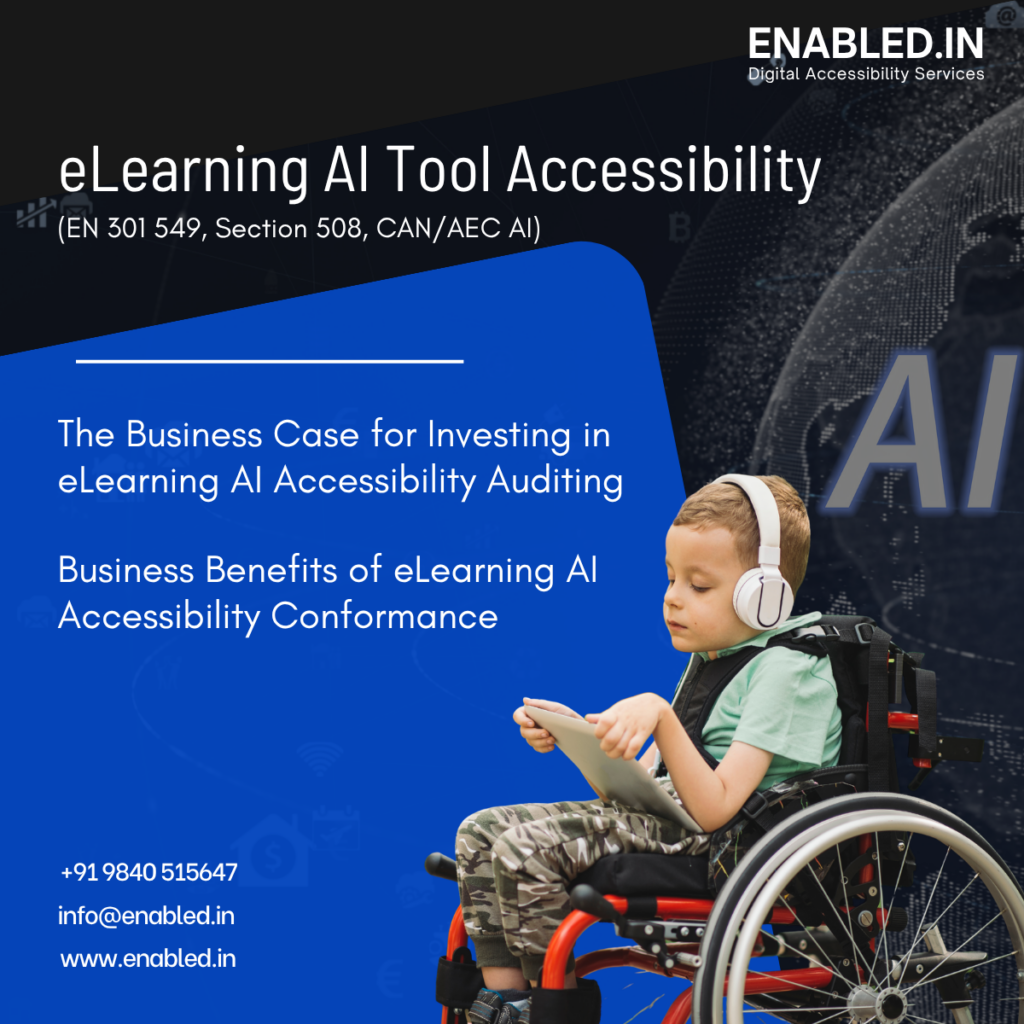
Evolution of AI-Powered Learning Platforms
Modern eLearning platforms leverage AI for personalization, predictive analytics, and automated assessments. These systems analyze learner behavior to deliver customized experiences. While powerful, they also introduce risks if accessibility is not embedded from the start.
Role of Accessibility in Digital Education
Accessibility ensures that learners of all abilities can interact with digital content effectively. According to the technical guidance , accessibility must be integrated throughout the AI lifecycle from design to deployment to avoid systemic exclusion.
Why Accessibility in AI eLearning is Critical
- Preventing Digital Exclusion : AI systems that lack accessibility features can unintentionally exclude individuals with disabilities. This leads to unequal access to education and career opportunities. Inclusive systems ensure participation for all learners.
- Addressing Bias and Inequality : AI models often rely on historical data that may not represent diverse populations. This can result in statistical discrimination and unfair outcomes. The guide highlights that AI must be continuously monitored to prevent bias and ensure fairness .
- Legal and Compliance Requirements : Organizations must comply with global standards such as WCAG and regional regulations. Non-compliance can lead to lawsuits, penalties, and reputational damage.
- Enhancing Learning Outcomes : Accessible platforms improve engagement, retention, and completion rates. When learners can interact comfortably, they perform better.
Standards an eLearning AI Audit Must Cover
A credible eLearning AI accessibility audit is not limited to WCAG. The table below maps the full standards landscape to the specific concerns of AI-powered eLearning platforms.
| Standard | Scope | Key eLearning AI implications |
| WCAG 2.2 (ISO/IEC 40500) | Web & app interfaces | Perceivable, Operable, Understandable, Robust criteria applied to AI-generated UI, dynamic content, chat interfaces, and real-time outputs |
| EN 301 549 / CAN/ASC | All ICT products & services | §4.2 Functional Performance Statements covering all 11 disability categories; §9 (web), §10 (docs), §11 (software), §12 (ICT hardware) — full platform scope |
| ASC Technical Guide — Accessible & Equitable AI (2024) | AI systems specifically | Accessible AI participation, equitable AI decision-making, organisational processes, accessible education & training |
| Accessible Canada Act | Federal organisations & regulated entities | Barrier identification, removal, and prevention obligations; “nothing without us” principle; barrier-free Canada by 2040 |
| UN CRPD (Article 9, 21, 24) | International human rights | Accessibility, freedom of expression and information, inclusive education as rights — not privileges |
| EU Artificial Intelligence Act | High-risk AI systems | Transparency, human oversight, and risk management for AI tools used in education — classified as high-risk |
| ISO/IEC 42001 — AI Management System | AI governance | Responsible AI deployment framework; risk management aligned with accessibility obligations |
| ATAG 2.0 | Authoring tools | AI content-generation tools must be accessible to authors with disabilities AND must produce accessible content by default |
Core Components of eLearning AI Tool Accessibility
User Interface Accessibility
A critical part of any audit involves evaluating:
- Screen reader compatibility
- Keyboard navigation
- Color contrast
- Responsive layouts
Interfaces must meet accessibility benchmarks to ensure usability.
Multimedia and Content Accessibility
Accessible content includes:
- Captions and transcripts
- Audio descriptions
- Non-flashing visuals
This ensures learners with sensory impairments can engage fully.
AI Behavior and Decision Transparency
AI systems must provide:
- Explainable decisions
- Bias detection mechanisms
- Human override options
Transparency builds trust and accountability.
Learning Analytics Accessibility
Dashboards should be:
- Screen-reader friendly
- Easy to interpret
- Free from color-only indicators
Assistive Technology Compatibility
Systems must support:
- Screen readers
- Voice input tools
- Switch devices
Compatibility ensures seamless interaction.
Privacy, Consent, and Ethical AI
The guide stresses the importance of informed consent and user control. Users should have the ability to opt out or request human intervention .
Priority Focus Areas for an eLearning AI Accessibility
AI-Generated Content Accessibility
Every piece of content an AI generates quiz questions, summaries, lesson plans, feedback must meet the same accessibility standards as human-authored content. The critical difference is that AI content is often produced in real time, at scale, with no editorial review.
Real-Time Captioning and Transcript Accuracy
AI-powered captioning is now standard in eLearning platforms. But automatic speech recognition accuracy varies significantly by accent, domain vocabulary, speaker disability, and audio quality often falling below the 99% accuracy target needed for deaf learners to have equivalent access
AI Algorithm Equity and Statistical Discrimination Testing
This is the area most frequently overlooked in accessibility audits and the area the ASC Technical Guide addresses most urgently. Adaptive learning algorithms, AI assessment tools, and recommendation engines may systematically disadvantage learners with disabilities if people with disabilities are underrepresented in training data or if proxy variables introduce negative bias.
Assistive Technology Compatibility
AI features interact with assistive technology in unpredictable ways. Dynamic content updates, ARIA live regions, focus management during AI responses, and keyboard traps in AI chat interfaces are among the most common failure modes found in real-world testing.
Privacy, Consent, and Data Protection for AT Users
The ASC Technical Guide dedicates specific guidance to privacy: people with disabilities are particularly vulnerable to data abuse, and assistive technology metadata can inadvertently reveal sensitive accommodation information to session hosts, employers, or institutions. eLearning AI platforms frequently collect extensive behavioural data that, for learners with disabilities, amounts to sensitive health and disability data.
Cognitive Accessibility of AI Interfaces and Outputs
AI-powered eLearning often produces the most cognitively demanding interfaces in the platform AI chat panels, real-time feedback overlays, recommendation carousels, and adaptive content flows. Learners with dyslexia, ADHD, acquired brain injuries, or intellectual disabilities face compounding barriers when AI-generated complexity is layered onto already complex learning content.
The Business Case for Investing in eLearning AI Accessibility Auditing
Market access and procurement advantage
Government, higher education, and large enterprise eLearning procurement increasingly requires demonstrated accessibility conformance often specifically WCAG 2.2 AA and EN 301 549 compliance as a contract condition. Platforms that can present a verified, third-party accessibility conformance report are at a significant competitive advantage. Platforms that cannot may be excluded from public-sector procurement entirely.
In Canada alone, the federal government is the country’s largest employer and a major procurer of eLearning platforms. The Accessible Canada Act’s 2040 barrier-free mandate means accessibility conformance will shift from competitive advantage to table stakes within the current procurement cycle.
Legal risk reduction
Human rights complaints related to inaccessible digital services are rising year on year across Canada, the UK, the US, and the EU. AI-powered platforms carry heightened exposure because AI systems that produce discriminatory outcomes even unintentionally can be characterised as systemic discrimination rather than individual inaccessible features. The potential remedies, including systemic remediation orders, are significantly more costly than a proactive audit.
An independent accessibility audit creates a documented good-faith compliance effort, which is a material factor in human rights adjudication and in defending against procurement challenges.
Expanded total addressable market
Learners with disabilities represent approximately 16% of the global population a market segment that is systematically underserved by inaccessible platforms. Accessible platforms also benefit older learners (a rapidly growing segment of workplace learning), learners in low-bandwidth or noisy environments who benefit from captions and transcripts, and non-native speakers who benefit from plain language and adjustable speed. Accessibility investment compounds across user segments.
Reduced support burden and churn
Inaccessible AI features generate disproportionate support costs. Learners who cannot complete AI-gated activities, who lose their reading position in auto-scrolling AI transcripts, or who cannot submit AI chat queries using their keyboard generate support tickets, escalations, and ultimately churn. Proactive remediation is materially cheaper than reactive support at scale.
Brand and mission alignment
For eLearning platforms whose mission includes democratising education, inaccessible AI is a mission contradiction that stakeholders learners, educators, investors, and regulators — are increasingly willing to call out publicly. Demonstrable, third-party verified accessibility commitment is a tangible expression of organisational values that attracts mission-aligned customers, partners, and talent.
| Driver | Without audit | With enabled.in audit |
| Procurement | Excluded from public-sector bids | Verifiable WCAG 2.2 / EN 301 549 conformance report |
| Legal exposure | Systemic discrimination liability | Documented good-faith compliance programme |
| Market reach | ~16% of learners excluded | Platform accessible to all 11 §4.2 disability scenarios |
| Support costs | High ticket volume from AT users | Proactive fixes reduce support overhead |
| Reputation | Contradiction of inclusion mission | Third-party verified inclusive AI commitment |
| AI equity | Undetected bias disadvantaging disabled learners | Algorithmic equity baseline and monitoring framework |
Business Benefits of eLearning AI Accessibility Conformance
Compliance confidence
A structured audit against WCAG 2.2, EN 301 549 §4.2, and the ASC Accessible AI Technical Guide produces a Voluntary Product Accessibility Template (VPAT) / Accessibility Conformance Report (ACR) that procurement teams can submit directly. This document is the recognised currency of accessibility compliance in government and enterprise procurement.
Developer and product velocity
Remediating accessibility barriers discovered after launch is four to ten times more expensive than building accessibly from the start. An audit early in the product cycle or integrated into CI/CD pipelines catches issues when they are cheapest to fix and creates a shared accessibility standard that prevents regression over time.
AI product quality signal
Equity and bias testing of AI features is not only an accessibility requirement it is a product quality signal. An adaptive learning engine that performs consistently across diverse learner profiles is a better, more trustworthy product for all learners. The ASC Technical Guide’s guidance on disaggregated accuracy measurements and equity of outcomes aligns directly with best-practice AI model evaluation.
Educator and learner trust
Educators who adopt AI-powered eLearning tools are responsible to their learners. Evidence that a platform’s AI features have been independently audited for bias and accessibility gives educators confidence to deploy AI-generated content and AI-adaptive pathways without fear of inadvertently disadvantaging vulnerable learners.
Continuous improvement framework
The ASC Technical Guide explicitly requires ongoing monitoring, review, and refinement not a one-time check. An audit engagement that includes monitoring dashboards, re-test protocols, and feedback channel design gives organisations a continuous improvement framework that satisfies the “review, refinement, halting and termination” obligation in the guide.
Getting Started with enabled.in
An eLearning AI accessibility audit is most effective when it begins before a major feature release, procurement submission, or regulatory review. However, it is never too late to start and every day an AI-powered platform operates without accessibility assurance is a day of exposure for disabled learners and legal risk for the platform owner.
Three questions to ask before your next AI feature ships:
- Has our AI-generated content been tested by learners with disabilities, not just scanned by automated tools?
- Can we demonstrate that our adaptive learning algorithm does not systematically disadvantage learners with disabilities?
- If a government procurement team asked for our VPAT today, could we provide one that covers our AI features?
If the answer to any of these is uncertain, enabled.in’s eLearning AI Accessibility Audit and Testing Service is the structured next step.
How Enabled.in Delivers AI Accessibility Excellence
Comprehensive Audit Framework
Enabled.in combines WCAG, EN standards, and AI guidelines for full coverage.
AI-Specific Testing and Bias Detection
Advanced testing ensures fairness and eliminates discrimination risks.
Real User Testing
Testing with users with disabilities ensures real-world usability.
Compliance Documentation
Detailed VPAT and ACR reports support procurement and audits.
Continuous Monitoring
Ongoing testing ensures systems remain compliant and effective.
FAQs on eLearning AI Tool Accessibility Audit & Testing Services
They evaluate AI-based learning platforms for accessibility, compliance, and fairness.
They prevent exclusion, reduce bias, and ensure legal compliance.
WCAG, EN 301 549, Section 508, and AI governance frameworks.
Regularly, especially after updates or AI model changes.
Not entirely, but audits help minimize bias significantly.
Corporate training, education, healthcare, and government sectors.
Conclusion
AI-driven learning is transforming education, but without accessibility, it risks leaving many behind. eLearning AI Tool Accessibility Audit & Testing Services ensure that innovation remains inclusive, ethical, and compliant.
By embedding accessibility into AI systems, organizations can deliver better learning experiences, reduce risks, and build trust in their technology.
About enabled.in
enabled.in is a specialist digital accessibility services provider. It helps organizations across India, the US, Europe, and Canada. They build, audit, and maintain accessible digital experiences.
Our services include WCAG and EN 301 549 audits. We also handle Section 508 compliance and VPAT preparation. Additionally, we offer accessible development consultancy. Finally, we conduct user testing with people with disabilities.
Take the Next Step
If you are a product owner, AI leader, or digital transformation executive, act now. Integrate accessibility into your product strategy.
Learn how Enabled.in can help your organization build accessible, compliant AI products.
Reach out: our AI Accessibility Audit and Testing Services
Whatsapp: +91 9840515647 Or contact our accessibility experts to start your AI accessibility assessment and compliance roadmap today – info@enabled.in