VPAT? Everything Businesses Need to Know
You might have responded to an enterprise RFP. Or perhaps you sold software to a government agency, university, or large enterprise. In such cases, you’ve probably been asked for a VPAT. For many organizations, this request appears late in the sales process and quickly becomes a priority.
The good news is that a VPAT is much more than another compliance document. When prepared correctly, it demonstrates your organization’s commitment to digital accessibility, builds trust with potential customers, and simplifies enterprise procurement.
In this guide, we’ll answer the most common questions:
- What does VPAT stand for?
- VPAT used for?
- Who needs a VPAT?
- How is a VPAT different from an Accessibility Conformance Report (ACR)?
- How can your organization create one with confidence?
What Does VPAT Stand For?
VPAT stands for Voluntary Product Accessibility Template.
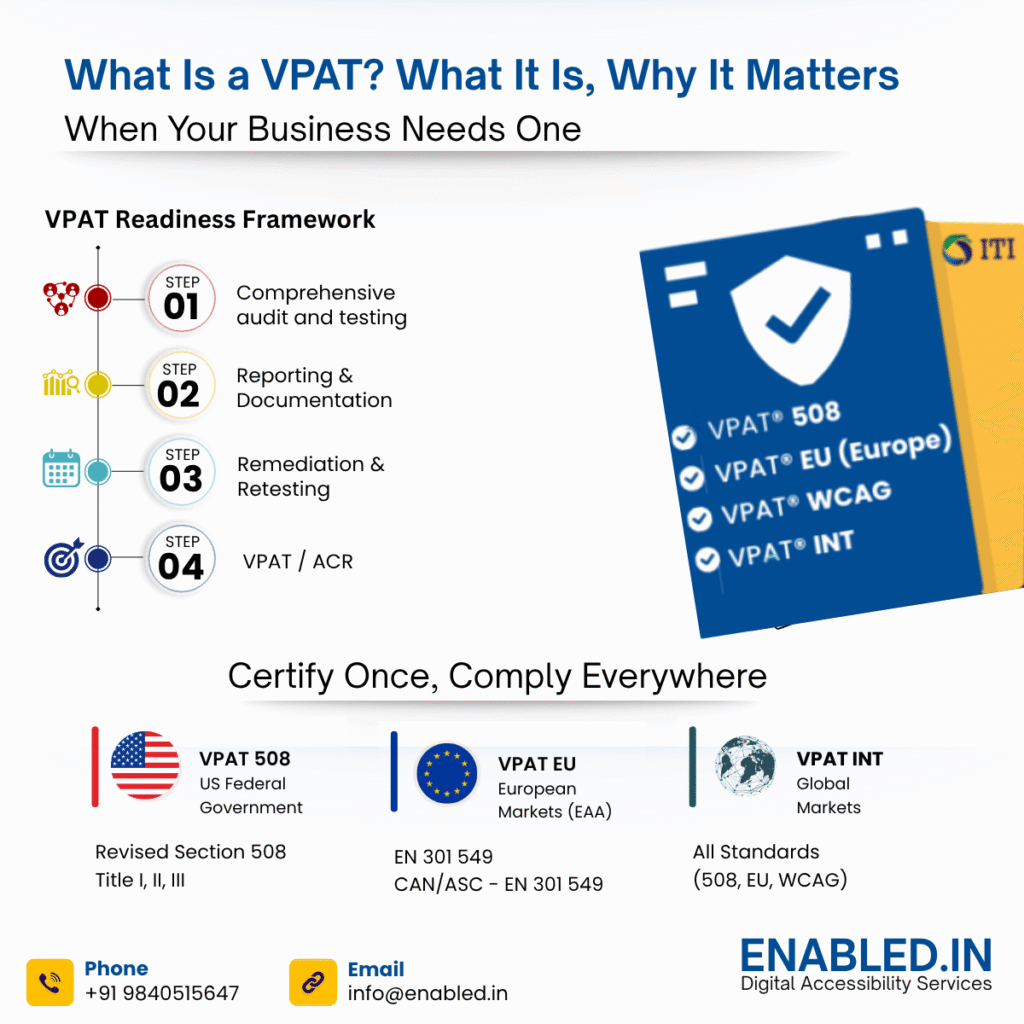
The Information Technology Industry Council (ITI) developed the VPAT as a standardized template. It allows software vendors to document how accessible their digital products are. This documentation is against recognized accessibility standards.
Although the word “voluntary” appears in its name, many organizations now expect a completed VPAT during the procurement process. If your company sells software to government agencies, educational institutions, or healthcare providers, you will likely need to provide one. The same applies if you sell to enterprise organizations.
What Is a VPAT?
A Voluntary Product Accessibility Template (VPAT) is a standardized document. It explains how well a digital product conforms to recognized accessibility standards.
Instead of simply claiming that a product is accessible, a VPAT provides detailed information about each accessibility requirement and whether it is:
- Supports
- Partially Supports
- Does Not Support
- Not Applicable
This helps procurement teams, compliance officers, and buyers. They can understand how people with disabilities use your product. It also helps in identifying any accessibility limitations.
Think of a VPAT as an accessibility assessment that promotes transparency. It is not a certification or a pass-or-fail document. Rather, it provides a structured overview of your product’s accessibility based on testing and evaluation.
VPAT Used For?
Organizations use VPATs to evaluate the accessibility of software before making purchasing decisions.
A VPAT is commonly requested during:
- Enterprise software procurement
- Government contracting
- Higher education purchasing
- Healthcare technology evaluations
- Vendor accessibility reviews
Vendors can avoid responding to dozens of accessibility questions separately. They can provide a VPAT instead. A VPAT presents accessibility information in a standardized and widely accepted format.
A well-prepared VPAT helps organizations:
- Demonstrate accessibility efforts
- Support enterprise sales
- Build customer confidence
- Reduce procurement delays
- Improve transparency during vendor evaluations
- Document accessibility testing results
Accessibility is becoming a standard procurement requirement. Having a current VPAT can significantly improve your ability to compete for enterprise contracts.
Why Are VPATs Becoming More Important?
Digital accessibility has become a business priority across industries.
Government agencies, universities, healthcare organizations, and large enterprises increasingly require vendors to demonstrate accessibility before purchasing software. Many procurement teams now include accessibility reviews alongside security, privacy, and compliance assessments.
Without a VPAT, organizations may experience longer procurement cycles, additional questionnaires, or even lose opportunities altogether.
Preparing a VPAT in advance helps businesses respond quickly to customer requests while demonstrating a proactive commitment to accessibility.
Who Needs a VPAT?
Any organization that develops or sells digital products can benefit from having a VPAT.
This includes:
- SaaS companies
- Software vendors
- Enterprise technology providers
- EdTech companies
- Healthcare technology providers
- Financial services platforms
- Government technology vendors
- Mobile application developers
- Website and portal providers
Even companies that primarily serve private-sector customers are increasingly receiving VPAT requests as enterprise accessibility expectations continue to grow.
VPAT vs. Accessibility Conformance Report (ACR)
Many people use the terms VPAT and ACR interchangeably, but they are not exactly the same.
A VPAT is the standardized template created by ITI.
An Accessibility Conformance Report (ACR) is the completed document after the VPAT has been filled out with accessibility evaluation results.
In simple terms:
| VPAT | Accessibility Conformance Report (ACR) |
|---|---|
| Standard template | Completed accessibility report |
| Blank document | Product-specific assessment |
| Reporting framework | Final deliverable shared with customers |
When customers ask for a VPAT, they are usually requesting the completed Accessibility Conformance Report.
What Standards Does a VPAT Cover?
Depending on the version selected, a VPAT can document accessibility against standards such as:
- Web Content Accessibility Guidelines (WCAG)
- Section 508 (United States)
- EN 301 549 (European Union)
The appropriate version depends on your target market and the accessibility requirements of your customers.
What Information Does a VPAT Include?
A typical VPAT includes:
- Product name and version
- Evaluation methods
- Applicable accessibility standards
- Accessibility support status
- Known accessibility limitations
- Detailed remarks and explanations
- Recommendations or future improvements
The objective is to provide an honest and evidence-based assessment rather than claiming perfect accessibility.
Common Misconceptions About VPATs
A VPAT is an accessibility certification.
False. A VPAT documents accessibility support but does not certify compliance.
Only government vendors need a VPAT.
Not anymore. Large enterprises, universities, healthcare organizations, and global companies increasingly request VPATs from vendors.
You need perfect accessibility before creating a VPAT.
No. Many organizations publish VPATs that acknowledge accessibility limitations while outlining planned improvements. Transparency is often more valuable than perfection.
When Should Your Organization Create a VPAT?
Many companies wait until a customer requests one.
A better approach is to prepare your VPAT proactively.
You should consider creating or updating your VPAT when:
- Launching a major product release
- Entering enterprise markets
- Responding to RFPs
- Selling to government organizations
- Expanding internationally
- Completing an accessibility audit
Keeping your VPAT current helps eliminate unnecessary delays during procurement.
How Is a VPAT Created?
Creating an accurate VPAT involves much more than filling out a template.
The process typically includes:
- Accessibility testing
- Manual evaluation by accessibility experts
- Automated accessibility scanning
- Assistive technology testing
- Documentation of findings
- Completing the VPAT template
- Internal quality review
A credible VPAT reflects actual testing and provides accurate information that procurement teams can trust.
Why Partner with Accessibility Experts?
Preparing a VPAT without comprehensive accessibility testing can result in inaccurate reporting and procurement challenges.
Working with accessibility experts helps organizations:
- Conduct thorough accessibility evaluations
- Identify compliance gaps
- Document findings accurately
- Prioritize accessibility improvements
- Create procurement-ready VPATs and Accessibility Conformance Reports
- Strengthen long-term accessibility programs
Professional guidance also provides engineering and product teams with practical recommendations to improve accessibility over time.
m helps simplify the process. We ensure your documentation reflects real accessibility outcomes.
How Enabled Helps You Prepare a VPAT
Preparing a VPAT requires more than simply completing a template. First, conduct a thorough accessibility evaluation of your digital product. Then, document accurately how it conforms to accessibility standards such as WCAG, Section 508, or EN 301 549.
At Enabled, we help organizations prepare procurement-ready VPATs through a structured process that includes:
- Comprehensive accessibility audits
- Manual and automated accessibility testing
- WCAG conformance evaluation
- Identification of accessibility gaps and remediation recommendations
- Preparation of VPATs and Accessibility Conformance Reports (ACRs)
- Guidance throughout enterprise and government procurement processes
Our accessibility experts assist in various situations. You might be responding to an RFP. Perhaps you’re preparing for a government contract. Or you could be meeting enterprise customer requirements. In each case, they ensure your VPAT accurately reflects your product’s accessibility status.
Ready to Prepare Your VPAT?
If your organization needs a professionally prepared VPAT backed by expert accessibility testing, Enabled can help.
Learn more about our VPAT Compliance services
Email: info@enabled.in
Our team will guide you through the complete process. We start with an accessibility assessment and offer remediation recommendations. Then, we prepare a procurement-ready VPAT that builds confidence with customers and stakeholders.
FAQ
Not in every situation. However, many government agencies, universities, healthcare organizations, and enterprise customers require a VPAT during vendor evaluation.
No. A VPAT documents how a product conforms to accessibility standards but is not an official certification.
A VPAT should be updated whenever significant product changes are released or after new accessibility testing is completed.
Yes. Having a VPAT demonstrates accessibility maturity, improves enterprise sales readiness, and helps reduce procurement delays.
Accessibility specialists working with product and engineering teams are best equipped to prepare an accurate VPAT based on comprehensive testing.
An accessibility audit identifies and documents accessibility issues. A VPAT summarizes how the product conforms to accessibility standards based on the audit findings.
Discover more from Enabled.in
Subscribe to get the latest posts sent to your email.