European Accessibility Act | Digital Accessibility
European Accessibility Act Implementation: Closing the Accessibility Gap
EAA compliance audit – The European Accessibility Act (EAA) has made digital accessibility an important operational responsibility for businesses providing covered products and services in the European Union. Yet many organisations still struggle to turn legal awareness into accessible customer experiences, products and internal processes.
A new AccessibleEU study published in October 2026 highlights this challenge. Businesses increasingly understand accessibility requirements, but many need practical support to implement them across procurement, product development, customer service and governance.
What Is an EAA Implementation Gap Assessment?
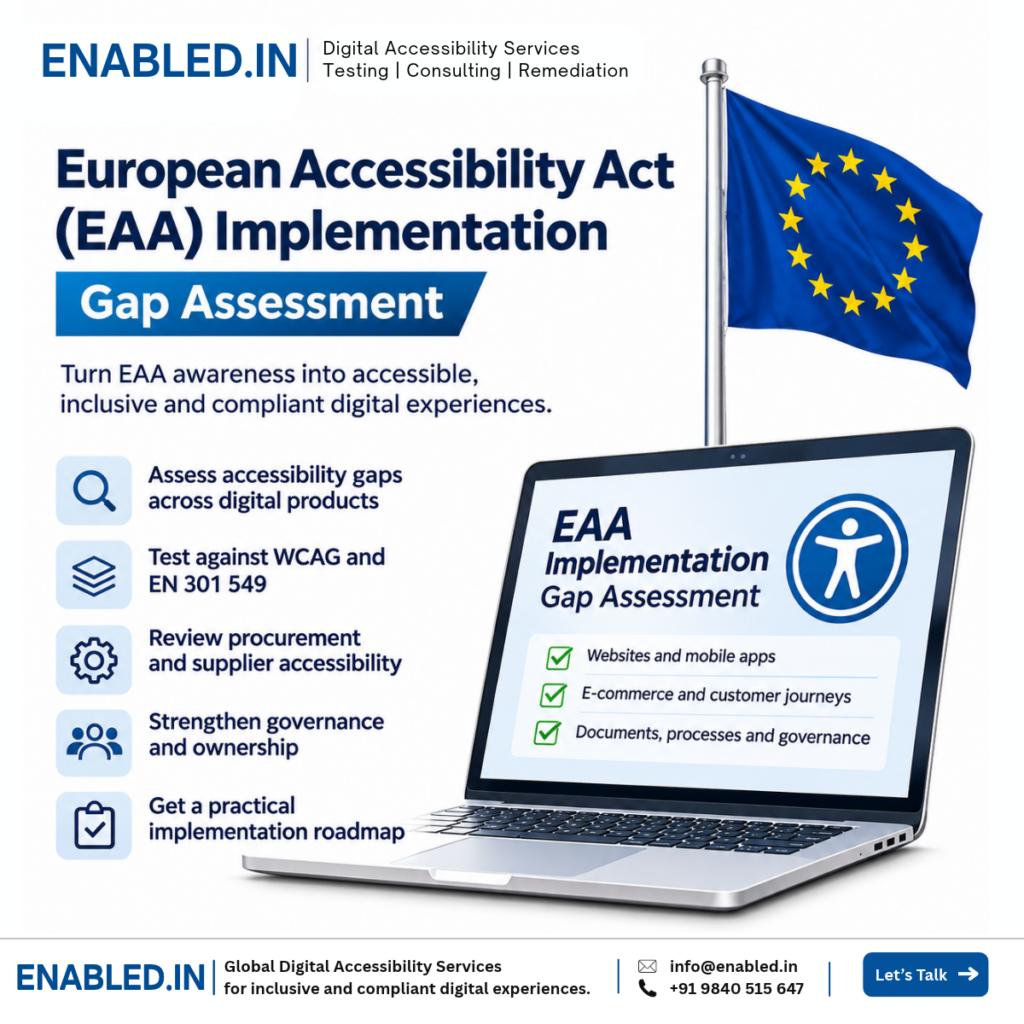
An EAA implementation gap assessment evaluates how effectively an organisation has translated applicable European Accessibility Act requirements into its digital products, services and business processes. It identifies accessibility barriers, supplier risks, documentation gaps and improvements needed in governance, testing and remediation.
What Does the 2026 AccessibleEU Research Reveal?
On 27 October 2026, AccessibleEU published a study examining how companies implement accessibility. The research gathered evidence from 75 companies through surveys, interviews, workshops and desk research.
The study describes increasing awareness of accessibility requirements alongside difficulties integrating accessibility into normal business operations.
Reported challenges include regulatory complexity, fragmented guidance, limited specialist expertise and inconsistent implementation across teams.
These findings highlight an important distinction: understanding accessibility legislation does not automatically mean that a digital product or service is accessible.
Research source: AccessibleEU study on how companies implement accessibility .
Why Do Businesses Struggle With EAA Implementation?
1. Accessibility Is Treated as a One-Time Audit
Some organisations evaluate accessibility only before a product launch or procurement review. However, software updates, new components and third-party integrations can introduce additional barriers.
2. Product and Development Teams Lack Clear Guidance
Designers and developers need actionable accessibility requirements, reusable component guidance and effective testing processes. A general compliance statement is not enough to guide implementation.
3. Third-Party Suppliers Are Not Fully Evaluated
Payment services, authentication providers, SaaS platforms and customer-support tools may introduce accessibility barriers into otherwise accessible customer journeys.
4. Automated Testing Is Mistaken for Full Compliance
Automated tools can identify many technical problems, but they cannot reliably evaluate every keyboard interaction, screen reader announcement or complex user workflow.
5. Accessibility Ownership Is Unclear
Without defined responsibilities across product, engineering, procurement and compliance teams, accessibility improvements may be inconsistent or difficult to maintain.
Understanding EAA, EN 301 549 and WCAG
Businesses should understand the relationship between European accessibility legislation and technical accessibility standards.
European Accessibility Act (EAA)
Directive (EU) 2019/882 establishes accessibility requirements for specified products and services. Its principal application date was 28 June 2025, subject to applicable national implementing laws, exceptions and transitional provisions.
EN 301 549
EN 301 549 provides accessibility requirements for information and communication technology products and services. The relevant edition and its legal status should be established for each assessment.
WCAG 2.2 Level AA
WCAG 2.2 AA provides a modern technical benchmark for assessing web content accessibility, including keyboard access, visual presentation, navigation, forms and interactive content.
Important: WCAG 2.2 AA conformance alone does not establish complete EAA legal compliance. Businesses must also consider applicable service, documentation and support requirements.
What Should an EAA Implementation Gap Assessment Cover?
A meaningful assessment should review both digital accessibility and the business processes responsible for maintaining it.
Digital Websites and Applications
- Public-facing websites and customer portals.
- Mobile applications and responsive interfaces.
- E-commerce product discovery and checkout.
- Online banking and payment journeys.
- Authentication, registration and account management.
Accessibility Testing
- Automated accessibility checks.
- Manual WCAG testing.
- Keyboard navigation and focus management.
- Screen reader compatibility.
- Zoom, reflow and responsive behaviour.
- Dynamic content and error handling.
Procurement and Governance
- Supplier accessibility requirements.
- Review of VPAT and ACR documentation.
- Accessibility responsibilities and ownership.
- Design-system and component-level controls.
- Release testing and regression prevention.
- Staff training and ongoing monitoring.
Documents and Customer Support
Assess relevant digital documents, service information, support channels and communication methods to identify barriers that may prevent customers with disabilities from accessing covered services.
A Practical EAA Implementation Roadmap
- Identify applicable services: Determine which products and services fall within the relevant legal scope.
- Inventory digital assets: Record websites, applications, workflows, documents and third-party dependencies.
- Conduct accessibility assessments: Combine automated checks, manual testing and assistive-technology evaluation.
- Prioritise barriers: Consider user impact, affected workflows, business criticality and remediation complexity.
- Implement remediation: Fix underlying components and workflows, with practical guidance for development teams.
- Validate corrections: Independently retest resolved issues and important user journeys.
- Maintain accessibility: Integrate testing, supplier review and governance into ongoing product delivery.
How Enabled.in Helps Businesses Implement Accessibility
Enabled.in provides digital accessibility auditing, testing, consulting and remediation validation services for organisations operating in global markets.
Our assessment approach combines technical testing, assistive-technology evaluation and practical implementation guidance to help businesses identify accessibility gaps and improve their digital services.
EAA Gap Assessment
Review digital products, accessibility processes, supplier dependencies and implementation gaps.
WCAG and EN 301 549 Testing
Assess websites, applications and critical workflows against agreed technical requirements.
Assistive-Technology Testing
Evaluate relevant workflows using NVDA, JAWS, VoiceOver, TalkBack and keyboard interaction.
Remediation Guidance
Provide developers with verified issues, reproduction steps and practical corrections.
VPAT and ACR Support
Prepare or review appropriate accessibility conformance documentation using verified evidence.
Retesting and Validation
Confirm accessibility fixes and support continuous improvement after product updates.
Legal applicability and country-specific obligations should be confirmed with qualified legal advisers. Enabled.in’s role is to support technical accessibility assessment, remediation and evidence-based reporting.
Frequently Asked Questions
When did the European Accessibility Act begin applying?
The EAA’s principal application date was 28 June 2025. National implementing laws, exceptions and transitional provisions may affect specific products and services.
Does WCAG 2.2 AA guarantee EAA compliance?
No. WCAG provides technical accessibility success criteria. EAA compliance may also involve service information, documentation, support and other legal requirements.
Can an accessibility widget make a website compliant?
No. A widget cannot independently resolve all semantic, keyboard, screen reader or workflow accessibility barriers.
Can businesses use an existing accessibility audit?
Yes. Existing reports can provide useful evidence. They should be reviewed for scope, product version, testing methods, unresolved issues and relevance to applicable requirements.
Does Enabled.in provide remediation validation?
Yes. Enabled.in can independently retest implemented fixes and validate critical workflows using manual and assistive-technology testing.
From Accessibility Awareness to Practical Implementation
The 2026 AccessibleEU research highlights a significant implementation challenge. Businesses need more than awareness of accessibility legislation. They need accessible products, clear responsibilities, effective supplier controls and ongoing validation.
An EAA implementation gap assessment provides a structured way to identify barriers, prioritise improvements and develop a practical accessibility roadmap.
Enabled.in supports this process through independent accessibility testing, remediation guidance, assistive-technology validation and conformance documentation.
References and Further Reading
Discover more from Enabled.in
Subscribe to get the latest posts sent to your email.