European Accessibility Act (EAA) Compliance for SaaS: The Complete Guide to EN 301 549 and WCAG 2.2 AA
If your SaaS product serves customers in Europe, accessibility is now a business requirement, not just a best practice.
Many enterprise customers and government organizations now ask:
“Is your product compliant with the European Accessibility Act (EAA) and EN 301 549?”
If you cannot provide a clear answer or an accessibility report, it can delay or even prevent new business opportunities.
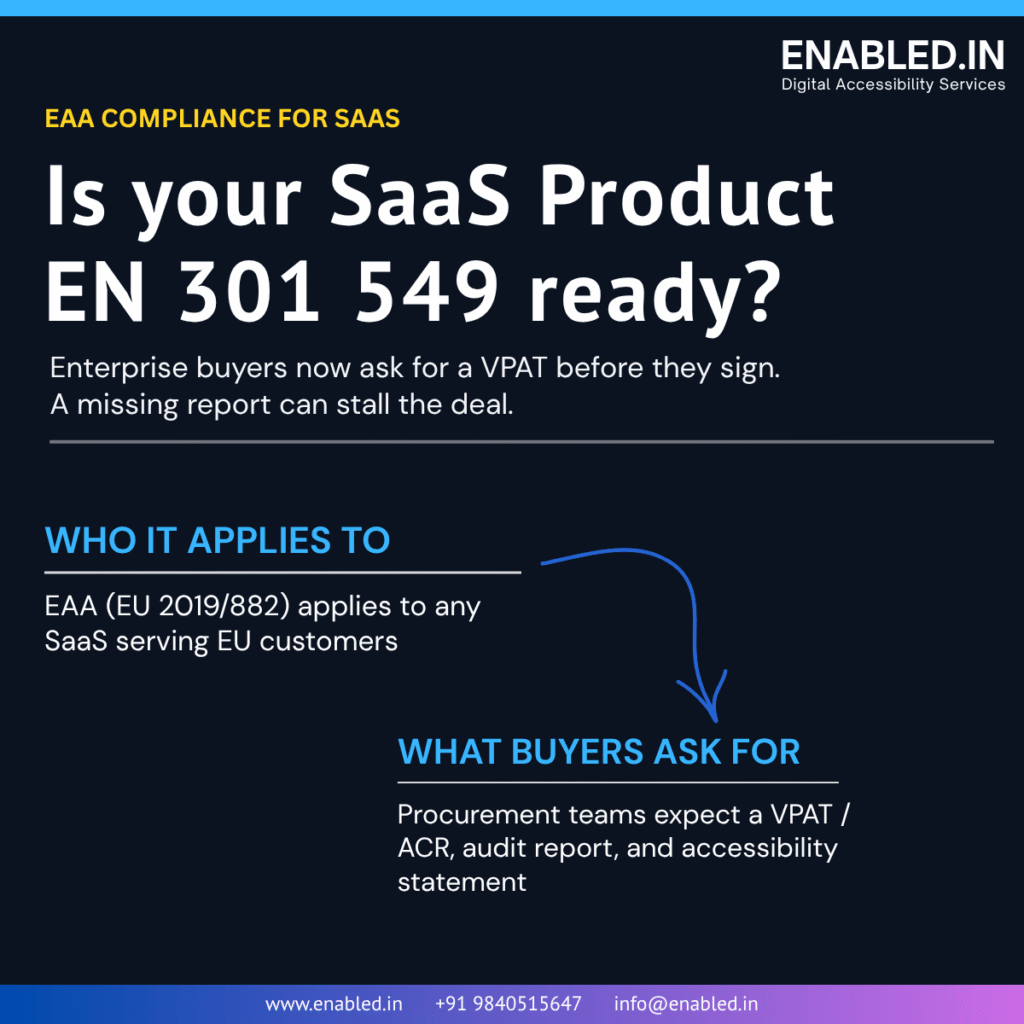
The European Accessibility Act (EAA) became applicable in June 2025. Since then, businesses offering digital products and services in the EU are expected to meet accessibility requirements. For SaaS companies, this typically means following EN 301 549, which references WCAG 2.2 Level AA for web accessibility.
In this guide, you’ll learn what the EAA means for SaaS products, how EN 301 549 and WCAG 2.2 AA work together, and the practical steps to achieve compliance.
Not sure where your product stands? Get a free accessibility consultation with Enabled.in →
What Is the European Accessibility Act (EAA)?
The European Accessibility Act (EAA) (Directive (EU) 2019/882) is a European law. It sets common accessibility requirements for digital products and services. These requirements apply across all EU Member States.
Its goal is to ensure that everyone, including people with disabilities, can use digital products and services independently.
This includes people with:
- Blindness or low vision
- Deafness or hearing loss
- Limited mobility
- Cognitive disabilities
- Speech impairments
- Temporary disabilities, such as a broken arm
The EAA applies even if your company is outside Europe. If you provide covered digital services to customers in the EU, your SaaS product may need to comply.
Digital Services Covered by the EAA
The EAA commonly applies to:
- SaaS platforms and customer portals
- Banking and FinTech applications
- Insurance platforms
- eCommerce websites
- Travel and booking platforms
- Healthcare portals
- Learning Management Systems (LMS)
- Customer support portals
- Mobile applications
- Online communication platforms
Why Accessibility Matters for SaaS Companies
Many SaaS companies focus on accessibility only when a customer requests proof of compliance during procurement. By then, fixing accessibility issues can be costly and delay the sales process.
Enterprise customers often ask for:
- VPAT® or Accessibility Conformance Report (ACR)
- EN 301 549 assessment report
- WCAG accessibility audit report
- Accessibility Statement
- Accessibility testing evidence
Without these documents, procurement can be delayed, or you may lose the opportunity to a competitor.
Business Benefits of Accessibility
Making your SaaS product accessible helps you:
- Reach more customers, including people with disabilities
- Improve the user experience for everyone
- Support better SEO with accessible, well-structured content
- Reduce support requests caused by usability issues
- Speed up enterprise procurement with ready compliance documentation
- Strengthen your brand and reduce legal and compliance risks
What Is EN 301 549?
The European Accessibility Act explains what organizations must achieve. EN 301 549 explains how to achieve it.
EN 301 549 is the European accessibility standard for Information and Communication Technology (ICT) products and services. It provides the technical requirements used to evaluate:
- Web applications and SaaS platforms
- Mobile applications
- Desktop software
- Documents (PDFs, Office files)
- Support services
- Authentication processes
For most web-based SaaS products, the majority of requirements come from Clause 9, which incorporates WCAG 2.2 Level AA as the foundation, layered with additional requirements for software, documents, authentication, and support.
Which EN 301 549 clauses apply to SaaS?
| Clause | Requirement | Typical SaaS Applicability |
|---|---|---|
| Clause 4 | Functional Performance Statements | Yes |
| Clause 5 | Generic ICT Requirements | Yes |
| Clause 6 | Voice Communication | If applicable |
| Clause 7 | Video Communication | If applicable |
| Clause 8 | Hardware | Usually No |
| Clause 9 | Web Accessibility (WCAG 2.2 AA) | Mandatory |
| Clause 10 | Non-Web Documents (PDFs, Office files) | If applicable |
| Clause 11 | Software (Desktop & Mobile Apps) | If applicable |
| Clause 12 | Documentation & Support Services | Yes |
| Clause 13 | Emergency Services | Rare |
For most cloud-based SaaS products, Clauses 4, 5, 9, and 12 form the core compliance scope.
Understanding Clause 9: Web Accessibility Requirements (WCAG 2.2 AA)
Clause 9 incorporates WCAG 2.2 Level AA, organized around four principles: Perceivable, Operable, Understandable, and Robust (POUR).
Accessibility Requirements for Authentication
Modern SaaS platforms rely on login, registration, SSO, MFA, OTP, and CAPTCHA. All of these can become accessibility barriers if not designed carefully. Provide accessible alternatives such as:
- Password manager and passkey support
- Accessible CAPTCHA solutions
- Email-based OTP and alternative verification methods
Security should never come at the cost of accessibility.
Clause 10: Accessible PDFs and Documents
If your SaaS generates downloadable reports, invoices, certificates, or manuals, those documents need to be accessible too. Best practices include tagged PDFs, correct reading order, alt text for images, accessible tables, searchable text, and document bookmarks.
Clause 11: Mobile and Desktop Applications
If your SaaS includes native software, such as iOS, Android, Electron, Windows, or macOS apps, Clause 11 applies. Testing should include VoiceOver, TalkBack, keyboard navigation, screen orientation, and dynamic text support.
Clause 12: Documentation and Support
Accessibility extends beyond the application itself. Help centers, FAQs, knowledge bases, user guides, support portals, contact forms, and live chat should all be accessible. This ensures users can get help regardless of disability.
Common Accessibility Issues Found in SaaS Products
Across audits spanning healthcare, finance, education, manufacturing, AI, retail, and enterprise software, Enabled.in consistently finds the same recurring gaps:
- Forms that cannot be completed using only a keyboard
- Missing labels for screen readers
- Low color contrast
- Inaccessible data tables and charts that rely solely on color
- Dialog boxes that trap keyboard focus
- File upload controls without accessible names
- Error messages not announced by assistive technologies
- Untagged PDF reports
- Login pages that fail screen reader testing
Automated tools catch only a fraction of these issues. Manual testing with real assistive technologies, including JAWS, NVDA, VoiceOver, and TalkBack, is essential to find what scanners miss.
Evidence Required for EN 301 549 Compliance
A comprehensive accessibility assessment typically produces:
- WCAG 2.2 AA audit report
- EN 301 549 conformance assessment
- Manual and automated testing results
- Screen reader testing (JAWS, NVDA, VoiceOver, TalkBack)
- Keyboard-only, zoom, and reflow testing
- Color contrast analysis
- Accessibility issue log with remediation verification
- Accessibility Conformance Report (VPAT®/ACR)
- Accessibility Statement
Keeping this evidence current not only supports compliance. It’s the exact documentation enterprise procurement teams ask for.
Want this checklist mapped against your specific product? Talk to an Enabled.in accessibility specialist →
Frequently Asked Questions
The SaaS product is offered to customers in the European Union. It falls within the scope of the EAA. You may need to comply regardless of where your company is headquartered.
WCAG 2.2 Level AA is the foundation for web accessibility under EN 301 549. However, SaaS providers should also address documentation, authentication, support services, and other applicable clauses.
Yes. If your platform generates downloadable documents, they should meet the requirements in Clause 10 of EN 301 549. If your platform provides downloadable documents, the documents should also meet these requirements.
No. Automated tools identify common issues but miss most real-world barriers. Manual testing with assistive technologies is essential for a defensible compliance position.
A VPAT® is a template used to produce an Accessibility Conformance Report (ACR). This report documents how a product meets accessibility standards such as EN 301 549. It’s the exact document enterprise buyers request during procurement.
Beyond compliance, accessibility improves usability, expands market reach, shortens procurement cycles, and strengthens brand reputation. Fixing issues early is also far cheaper than remediating after a customer complaint or audit.
How Enabled.in Helps SaaS Companies Achieve Compliance
Accessibility should never be a last-minute compliance scramble. At Enabled.in, we help SaaS companies build accessibility into every stage of the product lifecycle, including:
- European Accessibility Act readiness assessments
- EN 301 549 compliance audits
- WCAG 2.1 and WCAG 2.2 accessibility testing
- Manual and screen reader testing
- Mobile and desktop accessibility evaluations
- PDF accessibility audits
- Accessibility remediation guidance
- VPAT® and Accessibility Conformance Report (ACR) preparation
- Accessibility Statement drafting
- Continuous accessibility monitoring
You might be preparing for enterprise procurement. You could be expanding into Europe or improving product usability for every customer. In any of these scenarios, our specialists provide you with a practical and prioritized roadmap. They do not just offer a list of problems.
Ready to Make Your SaaS Accessible?
Accessibility is no longer something you can postpone. Customers are asking for it. Procurement teams are verifying it. Regulators increasingly expect it. And the companies that get ahead of it close deals faster than the ones that don’t.
Schedule a free accessibility consultation with Enabled.in.
In a 30-minute session, our team will:
- Review your product against EAA and EN 301 549 requirements
- Flag your highest-risk accessibility gaps
- Give you a practical, prioritized roadmap toward compliance, with no obligation and no jargon
Book Your Free Consultation -> Enabled’s A11Y Consultation . Response within 1 business day.
Prefer email? Contact Enabled.in today and start building software that everyone can use.
Download Checklist
European Accessibility Act Compliance Checklist for SaaS Products – EN 301 549 & VPAT
Discover more from Enabled.in
Subscribe to get the latest posts sent to your email.