U.S. Healthcare | ADA & Section 504
Can your healthcare organization show that patients can use its digital services without accessibility barriers?
Inaccessible appointment systems, patient portals, telehealth platforms and mobile apps can lead to complaints, legal action and costly fixes. An automated scan or an old report does not prove ADA compliance.
Enabled.in helps healthcare providers and software vendors find accessibility gaps, guide developers, verify fixes and prepare VPAT/ACR reports where needed.
Which U.S. healthcare accessibility laws apply?
Legal duties depend on your organization, funding and services. One rule does not cover every healthcare provider.
| Requirement | Who it may cover | What to review |
|---|---|---|
| ADA Title II | State and local government healthcare services | Covered websites and mobile apps |
| ADA Title III | Covered private hospitals and clinics | Barriers to covered healthcare services |
| Section 504 | Covered federal funding recipients | Applicable HHS web and mobile rules |
| Section 508 | Federal agency ICT and relevant procurement | Technology requirements and evidence |
Read Enabled.in’s ADA Title II digital accessibility guide for more information.
Current web and mobile compliance dates
| Covered group | Deadline |
|---|---|
| ADA Title II: Governments with populations of 50,000 or more | April 26, 2027 |
| ADA Title II: Smaller governments and special district governments | April 26, 2028 |
| HHS Section 504: 15 or more employees | May 11, 2027 |
| HHS Section 504: Fewer than 15 employees | May 10, 2028 |
The DOJ Title II and HHS Section 504 web and mobile rules use WCAG 2.1 AA, subject to scope and exceptions. WCAG 2.2 AA can be an added audit target. ADA Title III does not have the same general web deadline.
Official references: DOJ Title II guidance and HHS Section 504 guidance .
What healthcare services should be tested?
Start with services patients use to get care and manage their health.
| Digital service | Key tests |
|---|---|
| Hospital website | Navigation, provider search, forms and service details |
| Patient portal | Login, account recovery, records and messages |
| Appointments | Calendars, form errors and confirmations |
| Telehealth | Meeting controls, captions and chat |
| Mobile apps | VoiceOver, TalkBack, text resize and key tasks |
| Documents and payments | Medical PDFs, billing and payment confirmation |
| Third-party services | Booking, authentication, video and payment tools |
Find a doctor → Book an appointment → Register → Join a consultation → View results → Pay a bill
A barrier at one step may block the whole task.
What proof should an accessibility audit provide?
Healthcare teams need evidence they can act on, not just a scan score.
- Tested pages, apps, versions and patient journeys.
- WCAG requirements and testing methods.
- Confirmed issues and steps to reproduce them.
- Developer guidance and issue ownership.
- Re-test results and unresolved barriers.
- Scope limits and third-party exclusions.
Common findings include inaccessible calendars, unlabeled forms, missed error messages, poorly named telehealth controls and unreadable PDFs.
How Enabled.in Helps: From Audit to VPAT/ACR
- Scope and plan Confirm the product, requirements, patient journeys and test devices.
- Audit and test Use automated checks, manual review, keyboard and assistive technology testing.
- Report confirmed gaps Provide actual behavior, expected behavior, user impact, WCAG mapping and evidence.
- Support remediation Guide developers on fixes, including shared components across multiple screens.
- Re-test fixes Verify agreed corrections and record remaining issues.
- Prepare final report and ACR Deliver the updated audit report and VPAT-based ACR where needed.
VPAT/ACR is not ADA certification. It documents product conformance against the stated requirements and evaluation scope.
Who Can Use These Services?
Hospitals and healthcare providers
Review patient services, find critical barriers, plan fixes and keep audit evidence.
Patient portal, EHR and telehealth vendors
Test software modules, guide product teams, verify fixes and prepare an ACR when requested.
Development and QA teams
Receive clear issue reports, expected behavior and re-test results.
Healthcare ADA Compliance: Common Questions
Does every hospital follow the same ADA deadline?
No. Public entities and covered HHS funding recipients have different requirements. Private providers may have ADA Title III duties.
Does an automated scan prove ADA compliance?
No. Automated tools cannot test every patient task. Manual and assistive technology testing are needed to assess many barriers.
Must third-party patient portals be reviewed?
They should be considered when they support covered services or important patient tasks.
Is VPAT/ACR required for every healthcare website?
No. An ACR is often used for software procurement. It is not a universal ADA requirement or certificate.
Can Enabled.in support remediation and re-testing?
Yes. Enabled.in provides developer-ready findings, remediation guidance, verification and final reporting within the agreed scope.
Request a Healthcare ADA Accessibility Audit
Know your gaps. Fix the issues. Verify the results.
Enabled.in supports healthcare websites, patient portals, telehealth software and mobile apps with audits, remediation guidance, re-testing and VPAT/ACR preparation.
Discuss Your Healthcare Audit Scope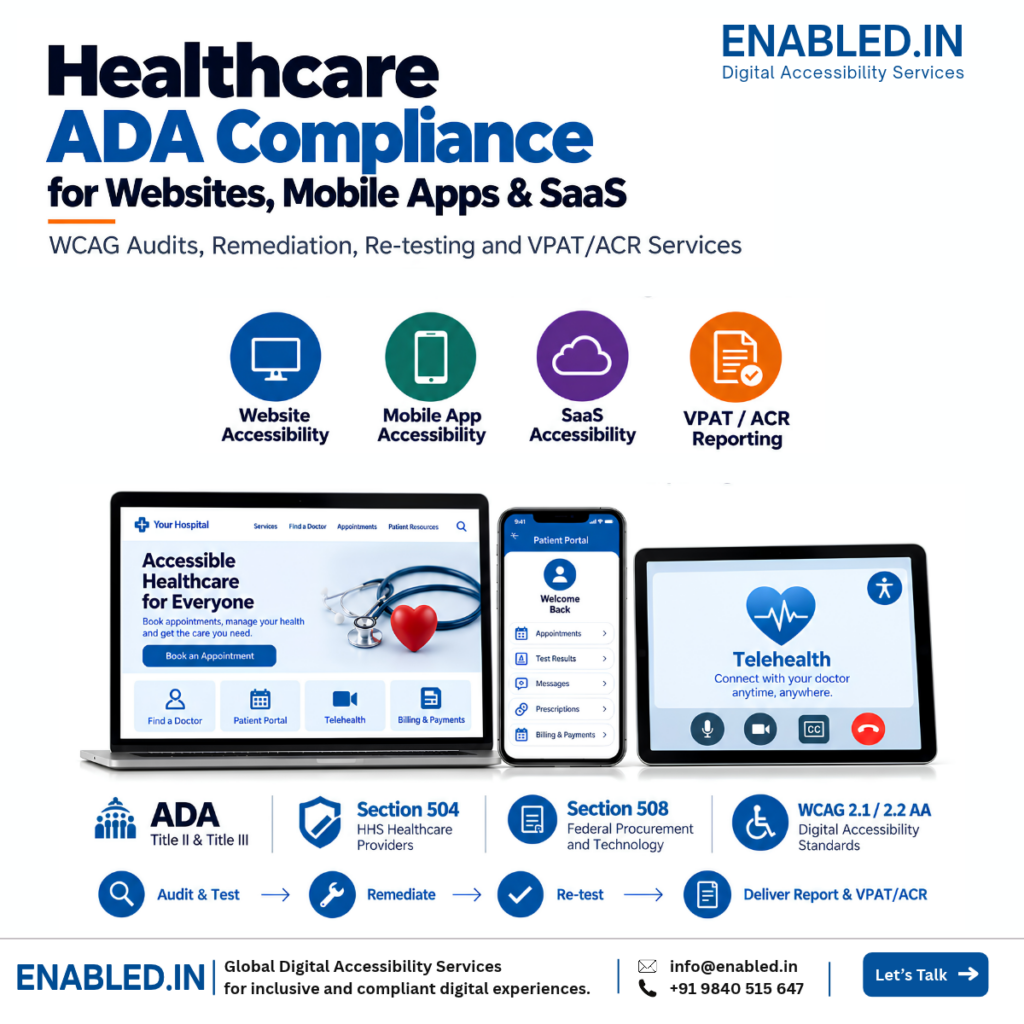
Discover more from Enabled.in
Subscribe to get the latest posts sent to your email.