KYC Accessibility: Why Inclusive Digital Identity Verification Matters
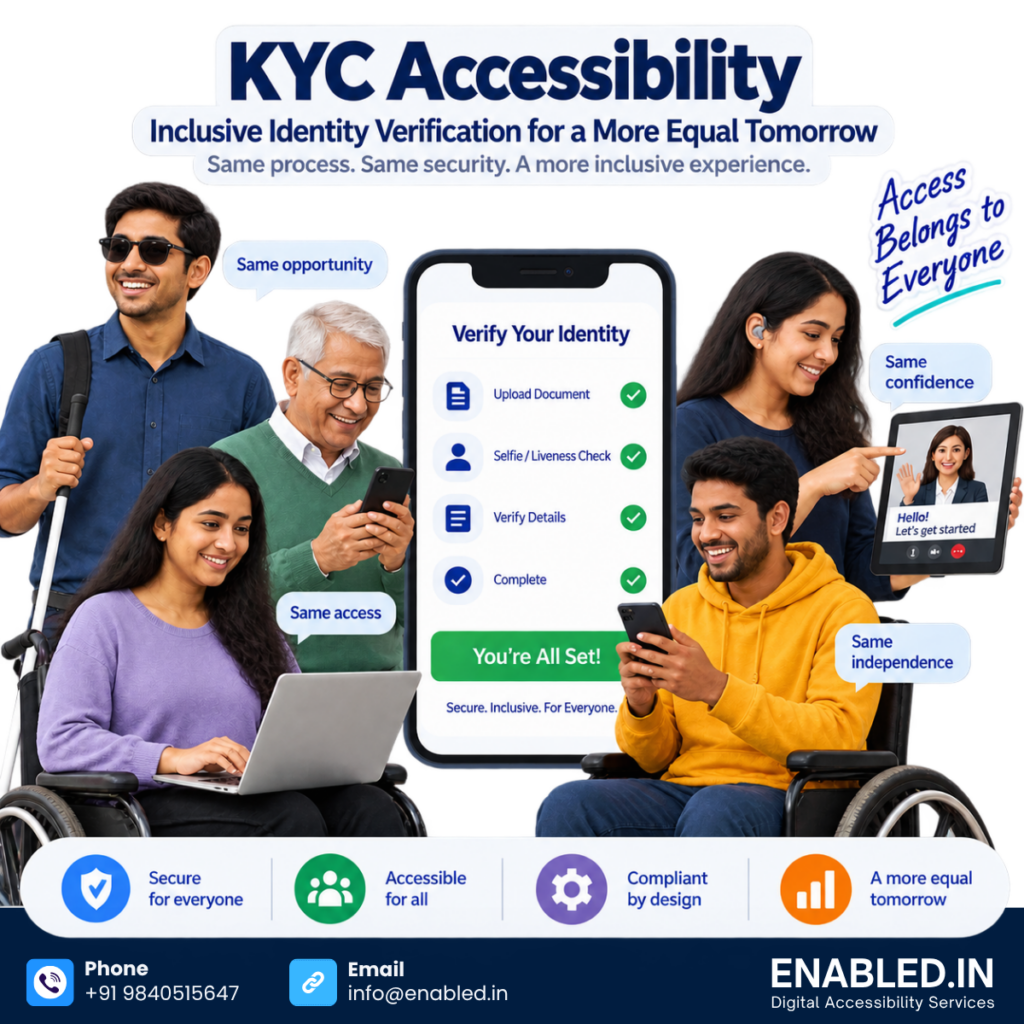
Digital KYC is now part of everyday life.
Banks use it to open accounts. Fintech companies use it to verify customers. Investment platforms use it before allowing people to trade.
- Insurance, payments and other regulated services also depend on KYC.
- For many customers, the process takes only a few minutes.
- For a person with a disability, it can be very different.
- A blind customer may be asked to position an ID card inside a visual frame.
- A person with limited facial movement may be asked to blink or turn their head.
- A person with limited hand movement may struggle with short OTP time limits.
- A deaf customer may receive spoken instructions without a text or visual alternative.
In these situations, the customer may not have failed identity verification.
The verification process may have failed to include the customer.
That is why KYC accessibility matters.
It is becoming an important issue for businesses, regulators and customers around the world.
What Is KYC Accessibility?
KYC accessibility means making identity verification usable by people with disabilities.
They should be able to complete the process independently and securely.
KYC accessibility can apply to:
- Account opening
- Registration
- OTP authentication
- CAPTCHA
- Document upload
- Camera-based document capture
- Facial recognition
- Liveness verification
- Video KYC
- Consent
- Electronic signatures
- Re-KYC
- Customer support
Accessibility does not mean reducing security.
It does not mean bypassing identity checks.
It means providing an accessible way to meet the same security requirement.
Who Can Be Affected by Inaccessible KYC?
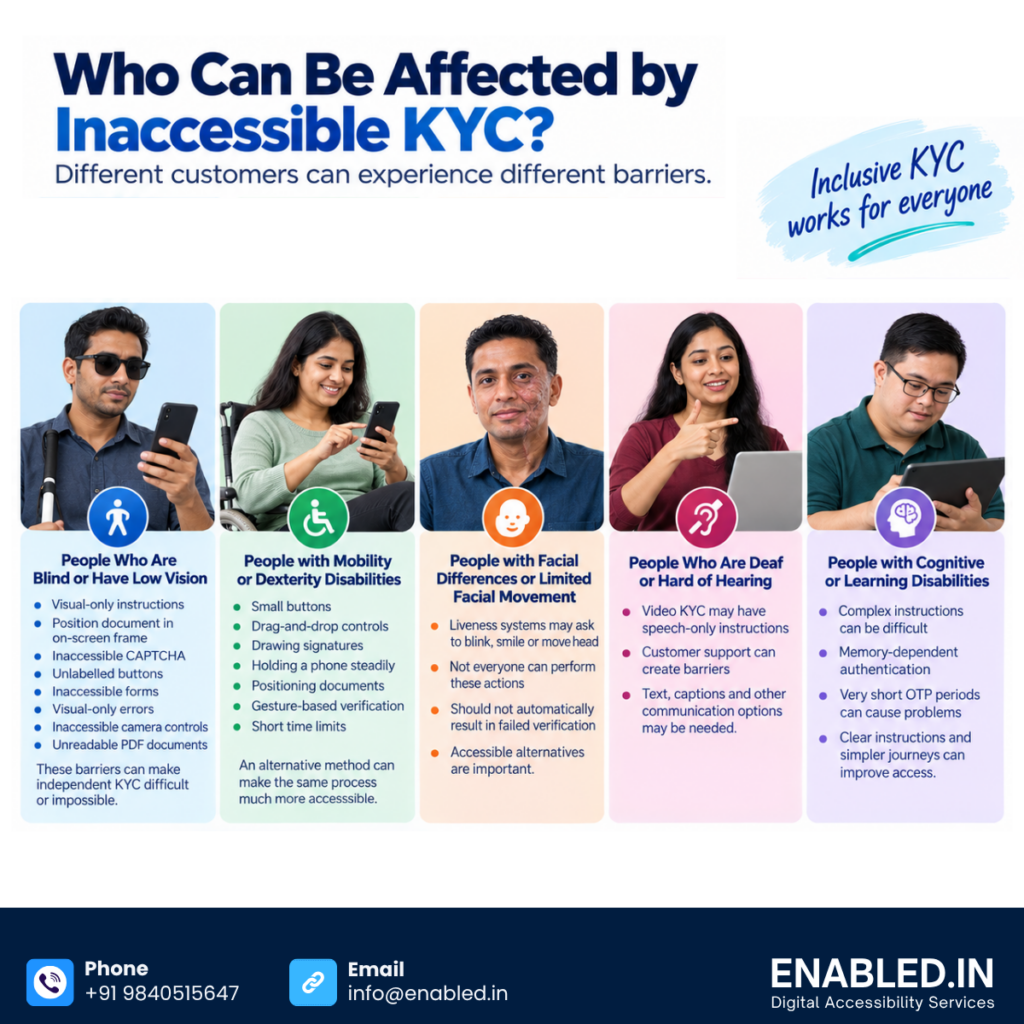
Different customers can experience different barriers.
People Who Are Blind or Have Low Vision
A KYC process may depend heavily on visual information.
For example, the customer may need to position a document inside an on-screen frame.
The application may also provide instructions only through visual cues.
Other barriers can include:
- Inaccessible CAPTCHA
- Unlabelled buttons
- Inaccessible forms
- Visual-only errors
- Inaccessible camera controls
- Unreadable PDF documents
These barriers can make independent KYC difficult or impossible.
People with Mobility or Dexterity Disabilities
Some customers cannot perform precise hand movements.
They may have difficulty with:
- Small buttons
- Drag-and-drop controls
- Drawing signatures
- Holding a phone steadily
- Positioning documents
- Gesture-based verification
- Short time limits
An alternative method can make the same process much more accessible.
People with Facial Differences or Limited Facial Movement
- Some liveness systems ask customers to blink, smile or move their head.
- Not everyone can perform these actions.
- A person’s disability should not automatically result in failed identity verification.
- Accessible alternatives are therefore important.
People Who Are Deaf or Hard of Hearing
- Video KYC can create barriers when instructions are provided only through speech.
- Customer support can create similar problems.
- Text, captions and other appropriate communication options may be needed.
People with Cognitive or Learning Disabilities
Complex instructions can make KYC difficult.
Memory-dependent authentication can create another barrier.
Very short OTP periods can also cause problems.
Clear instructions and simpler journeys can improve access.
Where Can KYC Become Inaccessible?
Accessibility barriers can appear at almost any stage.
Common problem areas include:
- Facial recognition
- Liveness verification
- Blinking requirements
- Camera positioning
- Document capture
- CAPTCHA
- OTP authentication
- Session timeouts
- Electronic signatures
- Consent
- Forms
- Error messages
- Video KYC
- PDF documents
- Customer support
Only one inaccessible step may be enough to stop the customer.
This is why organizations need to consider the complete KYC journey.
Third-party technology also needs attention.
A KYC vendor may provide facial recognition or document verification.
But the customer still sees it as part of your service.
Why Is KYC Accessibility a Legal and Compliance Priority?
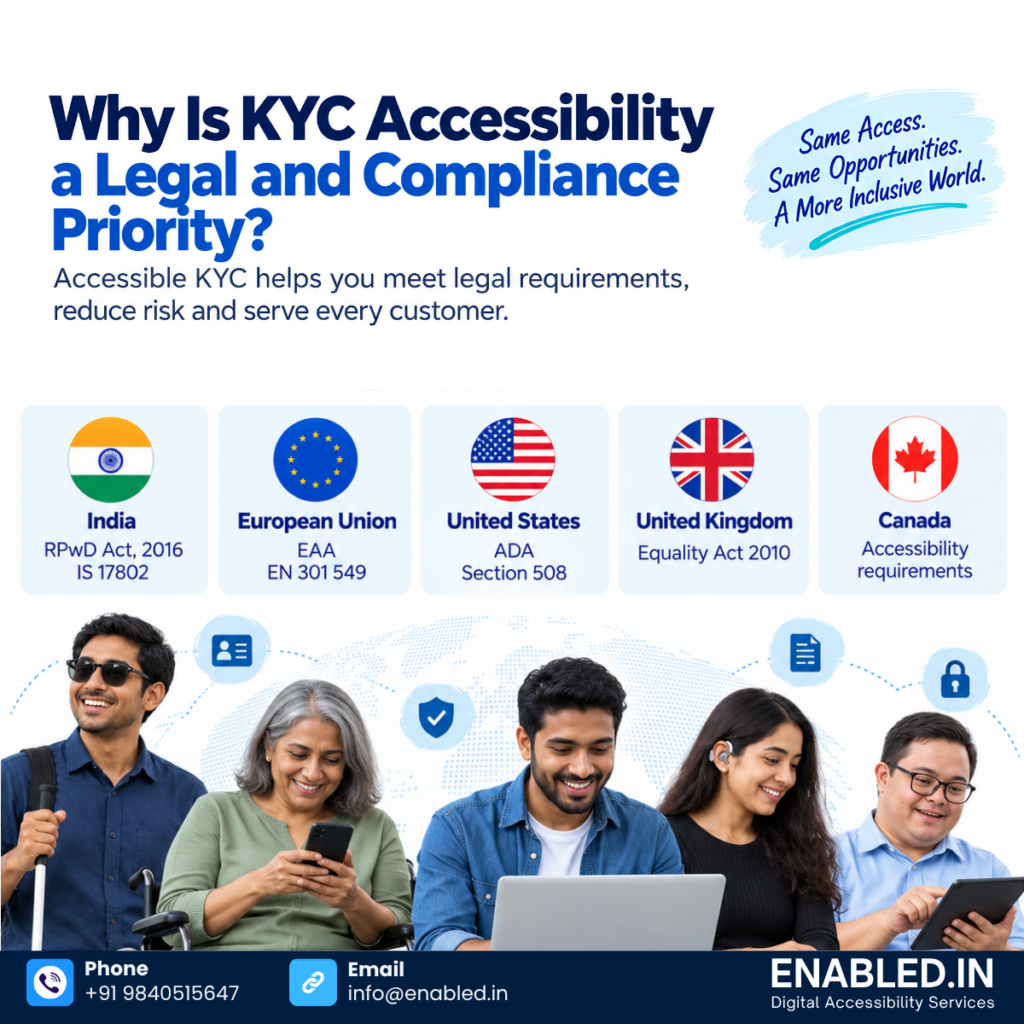
Accessibility is no longer only a usability consideration. Many countries have laws or standards covering digital accessibility.
Requirements can come from:
- Disability-rights laws
- Financial regulations
- ICT accessibility standards
- Government requirements
- Procurement contracts
The exact requirements vary by country and organization.
Several frameworks are especially important for KYC.
India: KYC Accessibility and Disability Rights
India has made significant progress in digital accessibility. The Rights of Persons with Disabilities Act, 2016 provides an important legal foundation. India also has IS 17802.
This standard addresses accessibility requirements for ICT products and services. KYC accessibility received greater attention after an important Supreme Court judgment in 2025.
The judgment emphasized the importance of accessible digital KYC. It also highlighted the need for appropriate alternatives.
These developments are important for:
- Banks
- NBFCs
- Fintech companies
- Payment providers
- Investment platforms
- Other regulated organizations
Accessibility should therefore be part of KYC governance.
It should not be treated only as a website issue.
European Union: European Accessibility Act
The European Accessibility Act (EAA) became applicable from 28 June 2025. It covers several consumer-facing products and services. This includes areas of consumer banking. Accessibility can therefore affect many parts of the customer journey.
Examples include:
- Websites
- Mobile applications
- Digital onboarding
- Authentication
- Identification
- Electronic documents
- Customer support
EN 301 549 is also an important European ICT accessibility standard. Third-party KYC technology should also be considered. Outsourcing identity verification does not remove the customer’s accessibility barrier.
United States: ADA and Section 508
Digital accessibility is also important in the United States. The Americans with Disabilities Act (ADA) is a major consideration.
ADA Title II contains digital accessibility requirements for covered state and local government entities. Private organizations may also need to consider responsibilities under ADA Title III.
Section 508 is important in federal ICT and procurement. WCAG is widely used as a technical accessibility benchmark. Accessibility can also affect procurement.
Customers may request a VPAT or Accessibility Conformance Report (ACR). An inaccessible KYC process can therefore create several risks.
These can include customer access, legal and procurement concerns.
United Kingdom: Equality Act 2010
The Equality Act 2010 is an important accessibility consideration in the UK. It creates responsibilities toward disabled people. It also addresses reasonable adjustments.
Organizations should consider accessibility across the complete digital journey. Making the homepage accessible is not enough.
The customer must also be able to complete account opening and identity verification.
Canada and Other Markets
Canada also has accessibility requirements. These exist at federal and provincial levels. Ontario’s Accessibility for Ontarians with Disabilities Act (AODA) is one example.
Other countries are also developing or strengthening digital accessibility requirements. Global organizations should therefore review each market they serve. One accessibility requirement may not automatically satisfy every jurisdiction.
Global regulations at a glance
| Region / Law | Applies to | Technical standard | Status |
|---|---|---|---|
| USA: ADA Title II | State & local government | WCAG 2.1 AA | Deadline Apr 2027 (large) / Apr 2028 (small) |
| USA: ADA Title III | Private business, incl. banks & fintechs | No official standard; WCAG 2.1 AA de facto | Enforced via litigation, ongoing |
| USA: Section 508 | Federal agencies & contractors | WCAG-aligned | In force |
| EU: European Accessibility Act | Banking, payments, e-commerce, telecom, transport | EN 301 549 (WCAG 2.1 AA → moving to 2.2) | In force since 28 June 2025 |
| UK: Equality Act 2010 | All service providers | WCAG as evidentiary standard | Anticipatory duty, ongoing |
| India: RPwD Act / IS 17802 / RBI Directions | Banks, NBFCs, fintechs, payment cos., insurers | IS 17802 (WCAG/EN 301 549-aligned) | In force; Supreme Court directions binding since Apr 2025 |
| Canada: AODA (Ontario) | Financial institutions in Ontario | WCAG 2.0 AA | In force |
Serving customers in more than one region? Talk to a KYC accessibility specialist at enabled.in → We help product teams build one accessible flow that satisfies WCAG, the ADA, the EAA, India’s Supreme Court directions and RBI rules, and other regional requirements at once, instead of maintaining separate versions per market.
The ROI Case Beyond Compliance
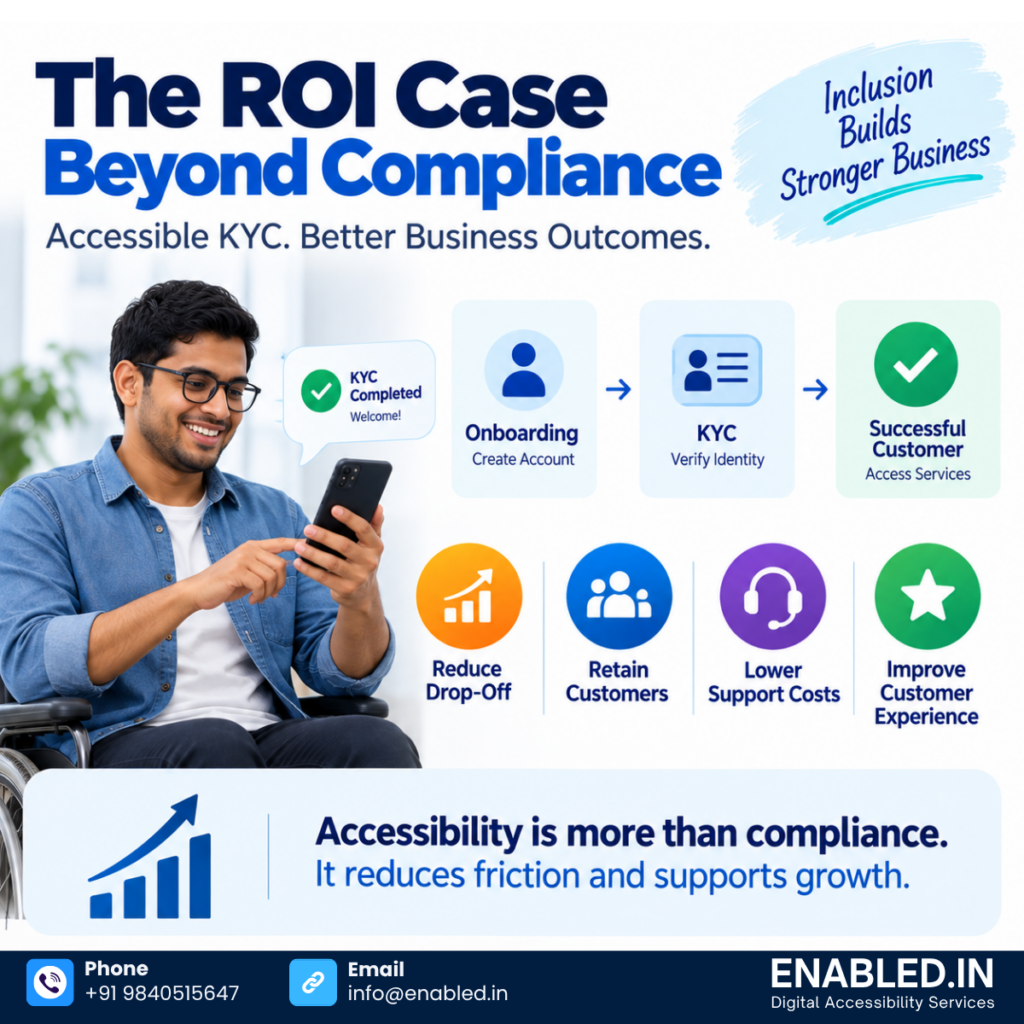
Compliance is the starting point. Accessibility also has a strong business value. Organizations spend heavily on customer acquisition.
They invest in:
- Advertising
- Marketing
- Digital products
- Onboarding
- Conversion optimization
A customer may complete most of the onboarding journey.
Then they reach KYC. An inaccessible verification step can stop them from continuing. The organization may lose a customer it has already paid to acquire.
Accessibility barriers can also create:
- Higher onboarding abandonment
- More support requests
- Manual verification escalations
- Customer complaints
- Additional remediation costs
- Procurement concerns
- Reputational risk
Inclusive design can also improve the experience for other customers. Clear instructions help everyone. Better error messages help everyone.
Reasonable time limits help many customers. Simpler processes reduce unnecessary frustration. Alternative verification methods can also improve recovery when technology fails.
Accessible KYC is therefore more than compliance.
It can reduce friction at an important point in the customer journey.
Who Should Pay Attention to KYC Accessibility?
KYC accessibility is particularly important for:
- Banks and digital banks
- NBFCs
- Lending platforms
- Fintech companies
- Payment providers
- Digital wallets
- Investment platforms
- Wealth-management platforms
- Stockbrokers
- Insurance companies
- Telecom providers
- Government services
- Identity-verification providers
- KYC technology companies
- SaaS platforms serving regulated industries
Organizations should also review third-party technology. Customers do not distinguish between your platform and your KYC provider. If they cannot complete verification, they experience it as a problem with your service.
How Should Organizations Approach KYC Accessibility?
KYC accessibility should not be a one-time activity. It should be part of product and compliance planning. Organizations should understand which accessibility requirements apply to them.
They should consider the complete customer journey. They should also consider third-party technologies.
People with disabilities should be included in the accessibility process. Accessibility should continue as the product changes. Global organizations may need to consider several frameworks.
These can include:
- WCAG
- IS 17802
- EN 301 549
- ADA
- Section 508
- European Accessibility Act
- Equality Act 2010
- Other regional requirements
The goal should not simply be to pass an accessibility audit.
The goal should be an accessible customer journey.
Download the KYC Accessibility Checklist
Need a practical starting point? Enabled.in has created a KYC Accessibility Checklist for Procurement & Compliance.
It covers key accessibility considerations for digital onboarding and identity verification.
The checklist can help:
- Product teams
- Compliance teams
- Procurement teams
- Design teams
- Engineering teams
- QA teams
- Accessibility teams
It covers important areas related to WCAG, ADA, RBI, SEBI, EAA, UK requirements and VPAT/ACR readiness.
Download the KYC Accessibility Checklist
Use the checklist as a starting point for internal discussions.
It can also support conversations with KYC and identity-verification vendors.
How Enabled.in Helps
Enabled.in helps organizations identify and address accessibility barriers across digital KYC and customer onboarding.
We look at the complete customer journey. That can include registration, authentication and identity verification.
It can also include document verification, consent and successful completion. Our services can support organizations with:
KYC and Onboarding Accessibility Assessment
We assess digital KYC and onboarding journeys.
This can include:
- Registration
- Authentication
- OTP
- CAPTCHA
- Document verification
- Camera interactions
- Facial verification
- Liveness verification
- Video KYC
- Consent
Enabled.in helps organizations understand and improve the accessibility of digital KYC, onboarding, websites and applications.
Talk to Enabled.in
Website: enabled.in
Email: info@enabled.in
Phone: +91 98405 15647
Download the KYC Accessibility Checklist
Frequently Asked Questions
What is KYC accessibility?
KYC accessibility means making identity verification accessible to people with disabilities.
Customers should be able to complete the process independently.
This includes document verification, authentication, OTP, video KYC and other identity checks.
Why is KYC accessibility important?
An inaccessible KYC process can prevent someone from accessing a service.
This can affect banking, investment, payments and other essential services.
It can also create legal, compliance and business risks.
Who can be affected by inaccessible KYC?
Many people can experience barriers.
This includes people who are blind or have low vision.
It also includes people who are deaf or hard of hearing.
People with mobility, dexterity, cognitive or neurological disabilities can also be affected.
Does WCAG apply to KYC?
WCAG is widely used as the technical foundation for digital accessibility.
It can be relevant to websites, applications and digital KYC journeys.
The exact legal requirement depends on the country, service and organization.
Which WCAG version should be considered for digital KYC?
WCAG 2.2 Level AA is a strong technical target for modern digital KYC services.
Organizations should also determine whether another WCAG version or accessibility standard is required by applicable law, regulation, contract or procurement requirement.
Is KYC accessibility important in India?
Yes.
India has the Rights of Persons with Disabilities Act and IS 17802.
The Supreme Court’s 2025 Pragya Prasun judgment also addressed accessibility barriers in digital KYC.
This has increased the importance of accessible identity verification and digital onboarding.
Does the European Accessibility Act affect KYC?
It can.
The European Accessibility Act covers several consumer products and services.
This includes areas of consumer banking.
Organizations serving EU customers should determine which accessibility requirements apply to their services.
Does the ADA affect digital KYC?
Digital accessibility can create ADA responsibilities in the United States.
The exact obligations depend on the organization, service and circumstances.
WCAG is widely used as an accessibility benchmark for websites and digital services.
What parts of a digital KYC journey should be tested for accessibility?
The complete customer journey should be considered.
This can include registration, forms, document upload, camera access, document capture, OTP verification, authentication, CAPTCHA, consent, liveness checks, video KYC, error handling and confirmation screens.
Testing should also consider third-party components used during the journey.
Can blinking be the only liveness verification method?
Organizations should not assume every customer can blink on demand.
Some people cannot perform specific facial movements.
Accessible alternatives should be considered where required.
Can facial recognition create accessibility barriers?
Yes.
Facial recognition and liveness verification can create barriers when customers must perform specific movements, maintain a particular position or respond within a limited time.
Organizations should evaluate these interactions and consider accessible alternatives where needed.
Should KYC work with screen readers?
Digital KYC journeys should be designed so that customers using screen readers can understand and operate relevant controls and information.
Testing can include assistive technologies such as NVDA, JAWS, VoiceOver and TalkBack, depending on the supported platforms.
Should KYC be fully keyboard accessible?
Web-based KYC functionality should support keyboard operation where the functionality can reasonably be operated through keyboard input.
Users should be able to navigate controls, forms, dialogs and other interactive elements without becoming trapped or losing track of keyboard focus.
Are OTP verification screens part of KYC accessibility?
Yes.
OTP entry can be an important part of authentication and identity verification.
OTP interfaces should provide accessible labels, clear instructions, understandable errors and sufficient time to complete the process.
Can time limits create accessibility barriers during KYC?
Yes.
Some customers may need additional time to read instructions, enter information, retrieve an OTP, upload documents or complete authentication.
Time limits should be evaluated against applicable accessibility requirements and suitable mechanisms should be provided where required.
Is CAPTCHA an accessibility concern in KYC?
Yes.
Some CAPTCHA methods can create barriers for people with visual, hearing, cognitive, motor or other disabilities.
Organizations should evaluate CAPTCHA accessibility and provide appropriate alternatives when necessary.
Is video KYC required to be accessible?
Video KYC can introduce accessibility barriers for customers with visual, hearing, speech, mobility or cognitive disabilities.
Organizations should assess the complete video KYC process and determine the accessibility requirements and reasonable alternatives that apply to their service.
Are document upload and camera capture part of accessibility testing?
Yes.
Accessibility testing should consider document selection, upload controls, camera permissions, capture instructions, image confirmation, validation messages and recovery from errors.
Customers should receive clear instructions and feedback throughout the process.
Are third-party KYC providers part of accessibility?
Yes.
Third-party KYC technology can introduce accessibility barriers.
This includes facial recognition, CAPTCHA, document verification, authentication and identity verification systems.
Organizations should consider accessibility when selecting, procuring and integrating these services.
Does using a third-party KYC provider remove an organization’s accessibility responsibility?
Organizations should not assume that outsourcing KYC automatically removes accessibility obligations or risk.
Third-party technology can become part of the customer journey.
Accessibility should therefore be considered during procurement, integration, testing and ongoing vendor management.
Should mobile KYC applications also be tested for accessibility?
Yes.
Mobile KYC journeys can contain accessibility barriers that differ from desktop websites.
Testing should consider supported mobile platforms, screen readers, touch interaction, orientation, text resizing, focus behavior and other relevant accessibility requirements.
Is automated accessibility testing enough for KYC?
No.
Automated tools can identify some accessibility issues, but they cannot reliably evaluate the complete KYC experience.
A stronger approach combines automated testing, manual testing, keyboard testing, assistive technology testing and testing with people with disabilities where appropriate.
What accessibility standard should organizations consider?
WCAG 2.2 Level AA is a strong technical target for modern digital services.
Other requirements may also apply.
These can include IS 17802, EN 301 549 and regional accessibility laws and regulations.
Can a VPAT or Accessibility Conformance Report cover a KYC solution?
A VPAT can be used to document the accessibility conformance of applicable technology products and services.
The appropriate VPAT edition and scope depend on the product, applicable standards and procurement requirements.
A VPAT should accurately reflect the evaluated product and supporting evidence.
When should accessibility testing begin in a KYC project?
Accessibility should be considered as early as possible.
Teams can review requirements, user journeys, designs and prototypes before development is complete.
Testing can then continue during development, before release and after remediation.
Where can I download the KYC Accessibility Checklist?
Enabled.in provides a practical KYC Accessibility Checklist.
It covers key accessibility considerations for digital KYC and onboarding.
Download the KYC Accessibility Checklist – WCAG, ADA, RBI, SEBI, EAA, UK & VPAT
Can Enabled.in assess our KYC journey?
Yes.
Enabled.in can assess web and mobile KYC journeys.
We can support WCAG 2.2 AA and other applicable accessibility requirements.
We also provide assistive technology testing, real-user testing, remediation guidance, re-evaluation and accessibility documentation.
Discover more from Enabled.in
Subscribe to get the latest posts sent to your email.