South Korea | Digital Accessibility 2026
Digital Inclusion Act, KWCAG and Accessibility Certification
A practical compliance guide for international websites, mobile apps, kiosks and digital product providers.
South Korea introduced a major digital accessibility framework in 2026. Organisations entering the Korean market need to understand the law, local standards and certification requirements.
Digital Inclusion Act KWCAG 2.2 WCAG 2.2 AA Quality CertificationWhat Are South Korea’s Digital Accessibility Requirements?
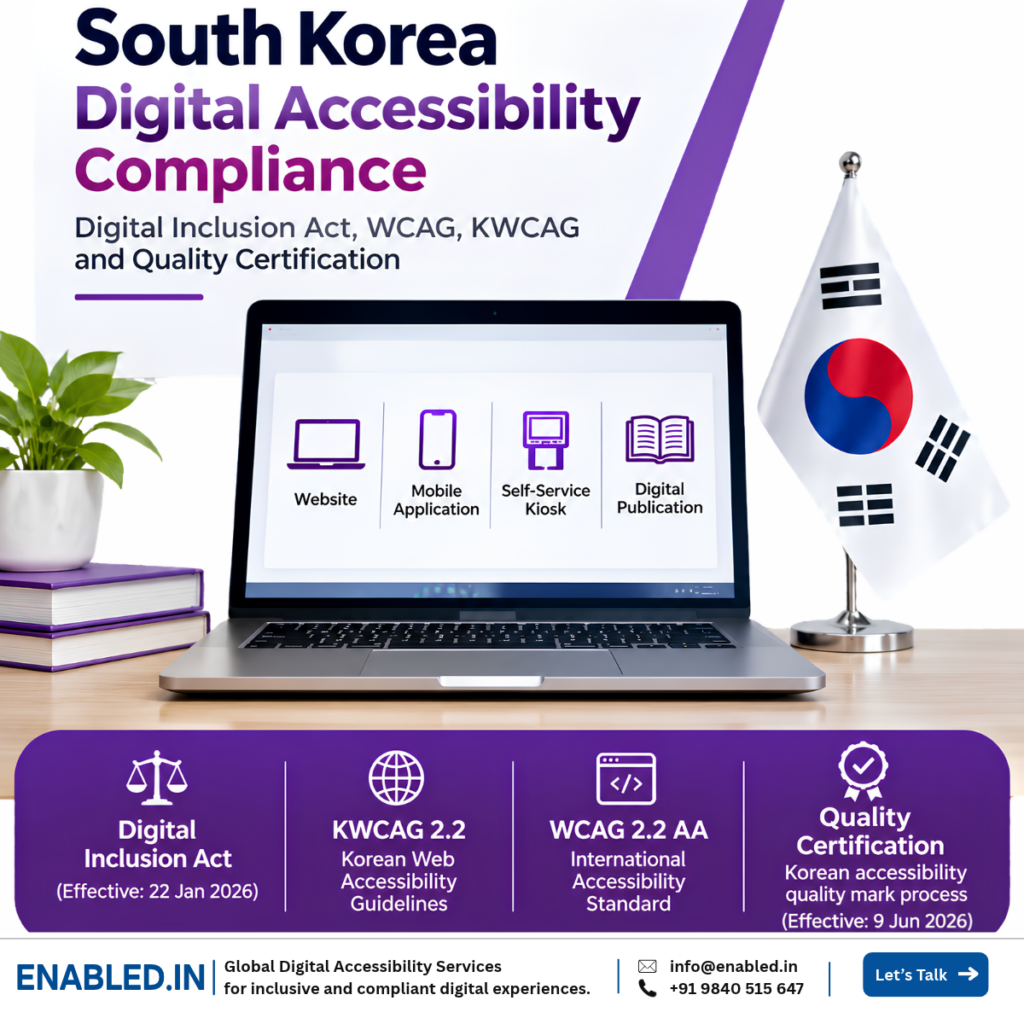
South Korea’s Digital Inclusion Act addresses accessibility of websites, mobile applications, self-service kiosks, electronic publications and other covered digital services.
Under Article 19, national and public institutions must ensure accessibility for listed products and services. Private providers must make efforts to improve access and usability for digitally vulnerable users.
Korean technical standards, including KWCAG, support accessibility evaluation. Official quality certification is a separate process.
Why South Korea Digital Accessibility Matters
South Korea has a highly connected digital economy. Public services, banking, shopping, education and everyday transactions depend on digital products.
Accessibility barriers can prevent people with disabilities, older adults and other digitally vulnerable users from accessing these services.
For international companies, meeting global WCAG requirements is an important first step. However, Korean market readiness also requires attention to local law, language, standards and certification expectations.
Key point: A WCAG 2.2 AA audit does not automatically establish full compliance with Korean law or grant Korean accessibility certification.
South Korea Accessibility Timeline
The Digital Inclusion Act was enacted.
The Act and implementing decree took effect.
The accessibility quality certification and testing notification took effect.
These developments provide a stronger legal and administrative framework for digital accessibility.
Which Digital Products Are Covered?
Article 19 identifies several types of digital products and services.
PRODUCT 01
Websites
Public portals, service websites, online applications and web-based platforms.
PRODUCT 02
Mobile Applications
Applications installed on mobile devices, including relevant customer service apps.
PRODUCT 03
Self-Service Kiosks
Defined unattended terminals used for information, ordering, payment and other services.
PRODUCT 04
Electronic Publications
Covered digital publications and their reading experiences.
Other categories may be defined by implementing regulations. The exact requirements depend on the provider, product and use case.
What Does the Digital Inclusion Act Require?
The Digital Inclusion Act (디지털포용법) supports better access to digital services and products.
Article 19 makes an important distinction between public institutions and private providers.
| Organisation | Article 19 Position | Practical Action |
|---|---|---|
| National and public institutions | Must ensure accessibility for listed services and products. | Assess covered services against applicable requirements. |
| Private providers | Must make efforts to improve access and usability. | Review accessibility risks and relevant legal obligations. |
| Public procurement suppliers | May face accessibility requirements through procurement and other applicable rules. | Confirm contract, procurement and certification expectations. |
Legal clarification: The Act does not impose identical wording on every organisation. Other Korean laws and procurement rules may also apply.
Digital Inclusion Act vs WCAG vs KWCAG
The law, technical standards and certification system serve different purposes.
| Framework | Purpose | Business Use |
|---|---|---|
| Digital Inclusion Act | Legal framework for digital inclusion | Identify Korean legal duties |
| KWCAG 2.2 | Korean web accessibility standard | Assess relevant Korean web criteria |
| WCAG 2.2 AA | International web accessibility criteria | Support global accessibility testing |
| Mobile Accessibility Guidance | Technical guidance for mobile interfaces | Evaluate mobile app accessibility |
| Quality Certification | Formal Korean assessment process | Support certification and procurement readiness |
Is KWCAG 2.2 the Same as WCAG 2.2?
No. KWCAG 2.2 is the Korean Web Content Accessibility Guidelines standard, KS X OT0003:2022. It references WCAG 2.1.
W3C WCAG 2.2 is a separate international recommendation.
International vendors should perform a criteria-level comparison rather than assuming that the two standards are identical.
Read KWCAG 2.2 and W3C WCAG 2.2 .
Korean Accessibility Quality Certification
South Korea has a quality certification framework for relevant accessible digital products and services.
The 9 June 2026 administrative notification provides detailed rules related to certification and test evaluation.
For website quality certification, the assessment process includes document review, expert evaluation and user evaluation.
Recommended Certification Readiness Process
Identify Scope
Confirm product type and relevant criteria.
Assess Gaps
Compare the product with applicable standards.
Audit
Perform manual, automated and assistive technology testing.
Remediate
Resolve identified accessibility barriers.
Retest
Validate fixes and complete user journeys.
Certification
Engage the relevant authorised Korean body.
Important: A technical audit, VPAT or Accessibility Conformance Report does not automatically grant Korean accessibility quality certification.
Certification is not universally mandatory for every private digital product.
Website Accessibility Testing
Website testing should cover more than individual pages. It should include complete user journeys.
A Korean-language web
page should identify
its main language
correctly, for example
using lang="ko"
on the HTML element.
Mobile Application Accessibility
Mobile applications are included in Article 19. Native, hybrid and web-based mobile experiences should be evaluated according to their applicable scope.
Key Mobile Testing Areas
- Accessible names and control roles
- Screen reader focus order
- Touch target size and spacing
- Text scaling and layout
- Gesture alternatives
- Authentication and verification
- Form errors and status messages
- Korean-language announcements
Testing should include relevant Android and iOS devices with TalkBack and VoiceOver.
Korean mobile accessibility guidance and applicable technical standards should be reviewed alongside international WCAG testing.
Kiosk and Self-Service Accessibility
Kiosks are used for ticketing, payments, information, ordering and public services.
Accessibility testing should cover both the digital interface and relevant physical interaction requirements.
Physical Access
Reach, controls, approach and operating positions.
Visual Access
Readability, contrast, instructions and visual feedback.
Nonvisual Access
Audio output, alternative interaction and accessible feedback.
Transactions
Payment, timeouts, error recovery and confirmation.
A software interface audit alone is not a complete kiosk accessibility assessment. Hardware and installation may require separate review.
Accessible Electronic Publications
Electronic publications are another category identified in Article 19.
Accessibility assessment may include headings, reading order, alternative text, tables, links, language identification and reading-system compatibility.
EPUB and PDF publications may require different technical standards. The appropriate standard should be selected for the document type and applicable obligations.
Common Accessibility Gaps for International Companies
| Current Practice | Potential Gap | Recommended Action |
|---|---|---|
| English-only testing | Korean-language experience not verified | Test representative Korean content and workflows |
| WCAG-only assessment | Korean criteria not mapped | Perform a KWCAG gap assessment |
| Automated scans | Complex interaction barriers remain | Add manual and assistive technology testing |
| Website-only audit | Mobile and kiosk experiences excluded | Evaluate all relevant product interfaces |
| Existing VPAT/ACR | Local evidence requirements may differ | Review procurement and certification expectations |
Korean-Language Assistive Technology Testing
Language and local user experience matter. A product tested only in English may have problems with Korean labels, pronunciation, instructions or navigation.
| Platform | Technology | Testing Focus |
|---|---|---|
| Windows | NVDA / JAWS | Keyboard access, forms and announcements |
| macOS | VoiceOver | Navigation and language handling |
| iOS | VoiceOver | Touch navigation and mobile journeys |
| Android | TalkBack | Focus, gestures and feedback |
| Local environments | Relevant Korean-language assistive technology | Local pronunciation and interaction patterns |
Where required, include qualified Korean-language testers and representative users.
South Korea Accessibility Readiness Checklist
This checklist supports planning and gap analysis. It does not replace legal review or official certification.
How Enabled.in Supports South Korea Market Readiness
Enabled.in provides accessibility evaluation and technical readiness services for international digital products.
WCAG and KWCAG Gap Assessment
Compare existing accessibility evidence with relevant Korean technical criteria.
Website and Mobile Audits
Test important pages, workflows and application interfaces.
Kiosk Interface Assessment
Review software accessibility barriers and support wider product evaluation.
Remediation and Retesting
Provide developer-ready findings and validate implemented fixes.
Assistive Technology Testing
Validate supported screen reader and keyboard interactions.
Certification Readiness Support
Prepare technical evidence for review by the appropriate authorised Korean body.
Service boundary: Enabled.in provides independent technical assessments and remediation support. Official Korean certification must follow the applicable authorised process.
Frequently Asked Questions
When did South Korea’s Digital Inclusion Act take effect?
The Act took effect on 22 January 2026.
Does the Act cover websites and mobile apps?
Yes. Article 19 includes websites and mobile applications among the listed digital services and products.
What is KWCAG 2.2?
KWCAG 2.2 is South Korea’s web content accessibility standard, KS X OT0003:2022. It is distinct from W3C WCAG 2.2.
Is WCAG 2.2 AA enough for Korean compliance?
Not necessarily. Korean legal and technical requirements must also be reviewed.
Is accessibility certification mandatory for every website?
No universal requirement should be assumed. The applicable legal, procurement and certification requirements must be confirmed.
Does a VPAT/ACR provide Korean certification?
No. A VPAT-based Accessibility Conformance Report documents assessed conformance. It does not grant official Korean certification.
Can Enabled.in support Korean market readiness?
Yes. Enabled.in provides accessibility audits, gap assessments, remediation guidance, assistive technology testing and retesting.
South Korea Accessibility Assessment
Is Your Digital Product Ready for the South Korean Market?
Identify accessibility gaps before launch, procurement review or certification planning.
Start with a focused assessment of your website, mobile application or kiosk interface.
Request an Accessibility AssessmentEmail: sathasivam@enabled.in
Phone / WhatsApp: +91 9840515647
Official References
- Digital Inclusion Act, Article 19
- Accessibility Quality Certification and Testing Notification, 2026
- Korean Web Content Accessibility Guidelines 2.2
- W3C WCAG 2.2
- Korean Web Accessibility Quality Mark Information
Reviewed November 2026. Confirm current legal requirements and certification procedures with relevant Korean authorities and qualified local specialists.
Contact a Digital Accessibility Expert
Sathasivam Kannupayan
Head of Digital Accessibility Services, Enabled.in. IAAP Certified Professional in Web Accessibility (CPWA), with over 17 years of experience in accessibility testing, enterprise application audits, assistive technology validation and VPAT/ACR.
Discover more from Enabled.in
Subscribe to get the latest posts sent to your email.