Your homepage accessibility scan may find hundreds of errors. But can a customer using a screen reader search for a product, add it to the basket and complete payment?
A 2026 study of French online retailers found accessibility barriers on every homepage tested. Many issues appeared again and again within the same site. This points to a key task for retail teams: fix shared components, then test the full shopping journey.
This guide explains the study, what it means for European Accessibility Act (EAA) planning and how retailers can test real customer journeys.
What Did the 2026 French E-commerce Accessibility Study Find?
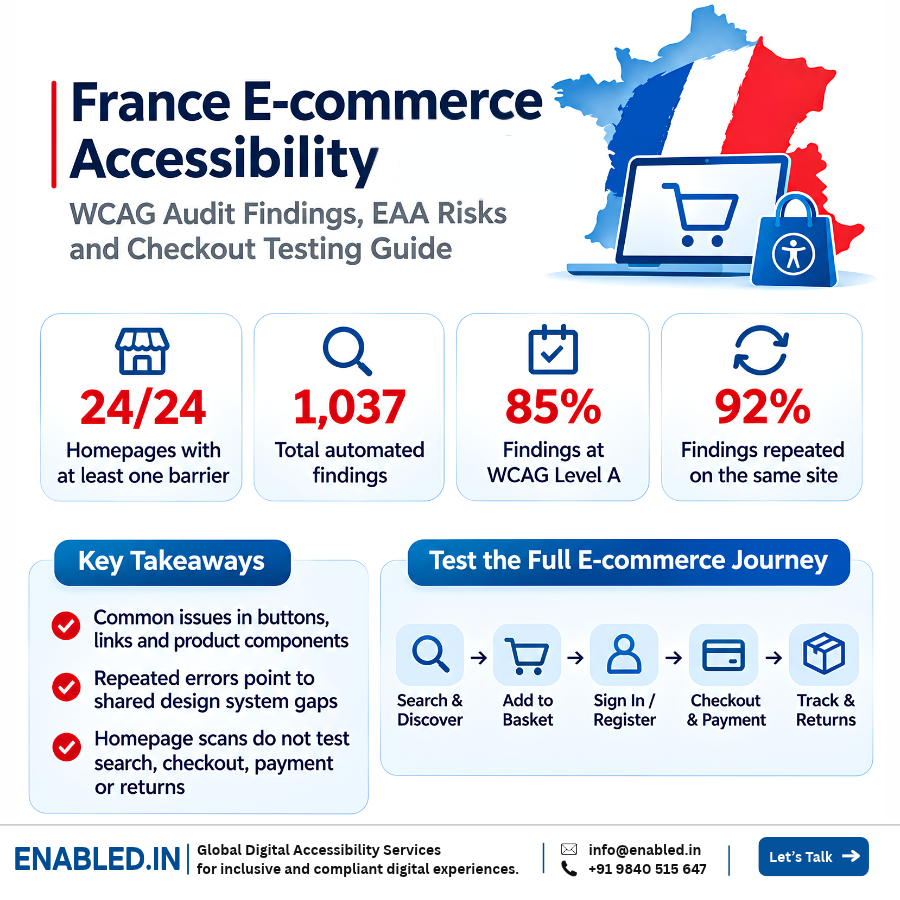
Corpowid scanned 24 online-shop homepages in France on 24 October 2026. Every homepage had at least one automatically detected WCAG 2.2 Level A or AA barrier. The study reported 1,037 findings in total.
Most findings were repeated issues within the same site. The results suggest that retailers should review shared components such as menus, buttons, product cards and carousels.
What Are the Main Accessibility Gaps in French Online Shops?
The study covered 24 homepages from online shops in grocery, fashion, home, beauty and electronics. It used automated WCAG 2.2 Level A and AA checks.
Five Findings Retailers Should Review
- Unnamed controls: Buttons, links and nested controls caused 485 findings across 22 sites.
- Page structure: Incorrect list and page markup caused 203 findings across 16 sites.
- Image alternatives: Missing text descriptions and unnamed image links caused 158 findings across 10 sites.
- Colour contrast: Weak text contrast caused 87 findings across 14 sites.
- Touch targets: Small targets caused 66 findings across nine sites.
The median homepage had 25 detected barriers. One homepage accounted for 331 of the 1,037 findings.
Study limitation: These are automated findings from homepages only. The study did not test complete purchase journeys, mobile apps or pages behind login.
The results do not prove that any named retailer is legally noncompliant.
Source: Corpowid, Digital Accessibility in France’s E-commerce Sector, 2026 .
Why Do Repeated Accessibility Errors Matter for E-commerce?
Online shops reuse the same buttons, menus and product cards across many pages. When one shared component has an access barrier, the same problem can appear again and again.
The study found that 92% of detected barriers repeated an issue already present on the same site. This suggests that component-level fixes could reduce many repeated findings.
| Component | Common Barrier | What to Fix |
|---|---|---|
| Navigation Menu | Unnamed buttons, incorrect structure | Accessible names, keyboard access, focus handling |
| Product Card | Unclear links, missing image text | Meaningful product names, clear actions, useful image alternatives |
| Carousel | Poor controls, confusing focus order | Named controls, keyboard operation, clear state changes |
| Add to Basket | Unnamed action, missing status feedback | Clear button name and announced updates |
| Cookie Banner | Focus traps, inaccessible choices | Keyboard access, clear labels, logical focus |
Example: One Button, Many Errors
A retailer uses the same unnamed “Add to basket” button on 50 product cards. An automated scan may report many instances of the same defect.
Fixing the shared button can address those instances. The team must still retest the component wherever its behaviour or context changes.
Key point: Fixing shared components can reduce repeated defects. It does not replace testing the full purchase flow.
What Does the European Accessibility Act Mean for French Online Retailers?
The European Accessibility Act (EAA) covers certain products and services, including e-commerce services offered to consumers. Its main requirements began to apply on 28 June 2025.
France has brought the EAA into national law. Covered retailers need to review the accessibility of their online shopping services, not just their homepages.
Four Points Retailers Should Know
- Scope matters: Check whether the service is covered by the French rules and whether any exemption or transition applies.
- Customer journeys matter: Review product search, selection, checkout, payment and support.
- Technical standards help: EN 301 549, RGAA and WCAG provide useful technical reference points. Their legal roles are not identical.
- Evidence matters: Keep audit results, remediation records, testing evidence and supplier information.
Important: WCAG 2.2 AA is a useful testing benchmark. Do not assume that every part of WCAG 2.2 is automatically a direct legal requirement under French EAA law.
Legal scope, exemptions, transitional provisions and applicable standards should be checked for each service.
A homepage scan can help teams find some technical issues. It cannot show whether a customer can complete an accessible purchase from start to finish.
Which E-commerce Customer Journeys Should Be Tested?
A customer may browse a website without difficulty but get blocked during payment or order tracking. That is why an audit should cover the full journey.
- Search and Product Discovery Can customers use search, filters, sorting and category navigation with a keyboard or screen reader?
- Product Selection Are product names, images, prices, sizes and options clear and accessible?
- Basket and Cart Updates Can customers add, remove and change quantities? Are updates announced to screen readers?
- Account and Authentication Can customers sign in, create accounts, reset passwords and complete verification without access barriers?
- Checkout and Delivery Are address fields, delivery choices, errors and order summaries accessible?
- Payment and Confirmation Can customers complete payment, understand errors and confirm the order?
- Order Tracking and Returns Can customers check delivery status, request returns and contact support?
What Testing Methods Should Be Included?
- Automated WCAG checks
- Manual accessibility testing
- Keyboard-only testing
- NVDA and JAWS on Windows
- VoiceOver on macOS and iOS
- TalkBack on Android
- Testing with people with disabilities
- Responsive layout and zoom testing
The test plan should include common tasks, error cases and important third-party tools such as payment gateways and login services.
A Five-Step Accessibility Plan for French E-commerce Teams
The most useful plan starts with repeated component defects and then checks the full customer journey.
- Map the journey: List key pages, shopping tasks, third-party tools and shared components.
- Audit shared components: Test menus, product cards, buttons, filters, forms and carousels.
- Test real transactions: Use manual and assistive technology testing from search to payment.
- Fix and validate: Give developers clear issue reports and retest the changes.
- Maintain accessibility: Add checks to design, development, procurement and release processes.
What Should the Audit Report Include?
- Page and component tested
- WCAG success criterion
- Steps to reproduce the issue
- Screenshot or other evidence
- Actual and expected behaviour
- Impact on users with disabilities
- How to fix the issue
- Retesting result and status
These fields help developers understand the problem and help product teams track progress.
How Enabled.in Helps French Retailers Improve E-commerce Accessibility
Enabled.in helps retailers move beyond homepage scan results and test the tasks that customers need to complete.
EAA E-commerce Journey Assessment
Review product search, product selection, basket, account access, checkout, payment, tracking and returns.
WCAG 2.2 AA Accessibility Audit
Combine automated checks with manual testing and assistive technology evaluation.
Component-Level Remediation Support
Group repeated issues by shared component and provide clear developer guidance.
Retesting and Accessibility Evidence
Validate fixes, review critical journeys and prepare clear conformance evidence where required.
Start with a Fixed-Scope EAA E-commerce Journey Assessment
The assessment can cover seven key shopping stages: search, product selection, basket, authentication, checkout, payment and post-purchase support.
The result is a clear list of access barriers, user impact, recommended fixes and priorities for the retail team.
Who should be involved? E-commerce directors, digital product owners, design-system teams, frontend developers, QA leaders, accessibility teams and legal advisers.
France E-commerce Accessibility FAQs
What did the 2026 French e-commerce accessibility study find?
Corpowid scanned 24 online-shop homepages in France and found 1,037 automated WCAG 2.2 Level A and AA barriers. Every tested homepage had at least one finding.
Why did 92% of the accessibility findings repeat?
The study found that 92% of barriers repeated an issue already found on the same site. Shared components such as buttons, menus and product cards may be a major cause.
Does an automated homepage scan prove EAA compliance?
No. Automated scans detect only some accessibility issues. They do not fully test keyboard use, screen reader behaviour, checkout or payment.
Which shopping journeys should retailers test?
Test search, product selection, basket, authentication, checkout, payment, order tracking and returns.
Does the EAA apply to French online retailers?
The EAA covers certain e-commerce services offered to consumers. French rules include scope conditions, exemptions and transitional provisions.
How can Enabled.in help with EAA readiness?
Enabled.in provides WCAG accessibility audits, shopping journey testing, assistive technology testing, remediation guidance, retesting and EAA gap assessments.
Can Every Customer Complete a Purchase?
Your homepage scan may identify repeated component defects. It cannot show whether a customer with a disability can complete checkout.
Enabled.in can help test your full shopping journey, identify access barriers and provide practical fixes for your team.
Email: sathasivam@enabled.in
Phone / WhatsApp: +91 9840515647
Sources and Further Reading
- Corpowid: Digital Accessibility in France’s E-commerce Sector, 2026 . Published 7 November 2026. Automated homepage scan conducted 24 October 2026.
- European Accessibility Act, Directive (EU) 2019/882 .
- Légifrance: French Legal Framework .
- RGAA: French Digital Accessibility Framework .
- W3C: Web Content Accessibility Guidelines 2.2 .
Research note: Corpowid’s study is a vendor-produced automated assessment of homepages. Its findings are useful for identifying common technical issues. They do not establish legal compliance for any named retailer.
Contact a Digital Accessibility Expert
Sathasivam Kannupayan
Head of Digital Accessibility Services,
Enabled.in
IAAP Certified Professional in Web Accessibility (CPWA), with more than 17 years of experience in digital accessibility audits, e-commerce accessibility, assistive technology testing and accessibility conformance reporting.
Discover more from Enabled.in
Subscribe to get the latest posts sent to your email.